Note Values: Whole, Half, Quarter, and Eighth Notes
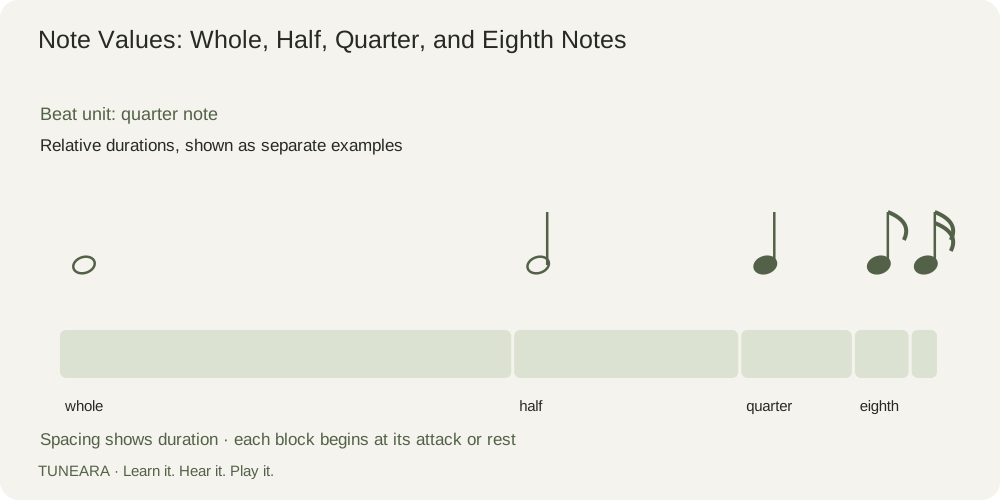
Note values give relative durations: a whole note equals two halves, four quarters, or eight eighths. The tempo and beat unit determine how long they last.
How musical note values divide a duration
A filled notehead with a stem is a quarter note. An open head with a stem is a half note, and an open head without a stem is a whole note. Flags or beams divide durations further. Two eighth notes occupy the same time as one quarter note when played without a special rhythmic alteration.
Count different note values within a measure
In 4/4 with the quarter note as the beat, a half note lasts two beats and an eighth note lasts half a beat. At quarter note = 60, that means two seconds and half a second. In a different meter or tempo marking, the relation to the click can change while the written note-value ratios stay the same.
Try it in practice
Count four steady beats. Sustain a whole note across all four, then play two half notes, then four quarter notes, then eight even eighth notes. Keep the measure length identical in every version. Say “1 and 2 and 3 and 4 and” to locate the eighth-note positions before speeding up.
Avoid a common mistake
A quarter note does not universally mean one second or even one metronome click. Check the beat unit first. Also keep the duration separate from the attack: holding a note for two beats does not mean striking it twice. The end of the note matters as much as its start.
Read the visual example
What to learn next
Connect this lesson to Treble Clef Notes: Lines, Spaces, and Landmarks, then try How to Read Sheet Music: A First-Pass Routine.
References and further learning

Get Tuneara
Your next practice
starts here.
A free tuner and metronome for iPhone and Android.