Bass Clef Notes: Read the Lower Staff
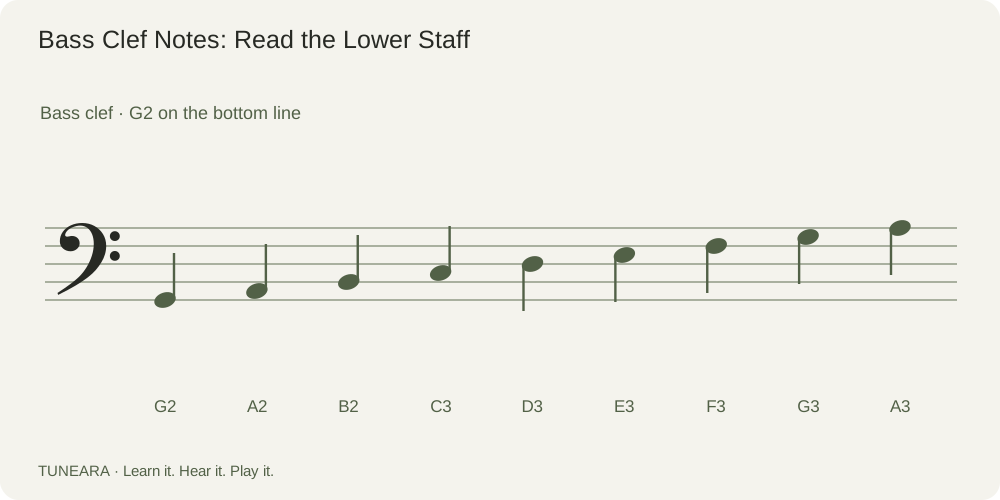
Bass clef marks F3 on the fourth line from the bottom. Its lines are G2, B2, D3, F3, and A3; its spaces are A2, C3, E3, and G3.
How the bass clef marks the F3 line
The two dots of the bass clef sit on opposite sides of the F3 line. Use that line as a landmark, then count through adjacent spaces and lines. Bass notation commonly serves lower instruments and a keyboard player’s lower part, but the clef itself describes pitch placement rather than a required hand or instrument.
| Position | Note names |
|---|---|
| Five lines | G2, B2, D3, F3, A3 |
| Four spaces | A2, C3, E3, G3 |
“Good Boys Do Fine Always” names the line notes G–B–D–F–A; “All Cows Eat Grass” names the spaces A–C–E–G. Read both lists from bottom to top. Use the diagram to check whether a notehead sits on a line or in a space before applying a memory phrase.
Find middle C and neighboring bass clef notes
Start from F3 and move down one staff position to E3, then D3, C3, and B2. Moving upward gives G3, A3, then B3 above the staff. Middle C, C4, is on the first ledger line above bass clef. It connects this staff to the same C4 below treble clef.
Try it in practice
Read F3, D3, G3, and C3 in an unpredictable order. Play or sing each after naming it, then return to the F3 landmark. Follow with a two-note pattern that alternates a line and its neighboring space. Practicing a small region reliably is more useful than guessing all the notes at once.
Avoid a common mistake
Do not reuse treble-clef line names on a bass staff. A note on the bottom line is G2 here, not E4. Also distinguish written from sounding pitch for octave-transposing instruments: electric bass notation normally sounds an octave below what is written. The diagram below labels bass-staff written positions.
Read the visual example
What to learn next
Connect this lesson to Treble Clef Notes: Lines, Spaces, and Landmarks, then try Note Values: Whole, Half, Quarter, and Eighth Notes.
References and further learning

Get Tuneara
Your next practice
starts here.
A free tuner and metronome for iPhone and Android.