Chromatic Tuner Explained: How It Works & When to Use It
← Back to Instrument tuning guides
A chromatic tuner detects notes across all twelve pitch classes, including sharps and flats, rather than restricting the display to one instrument’s standard string notes. It shows the nearest note and pitch deviation; you still need to know your intended target note and octave.
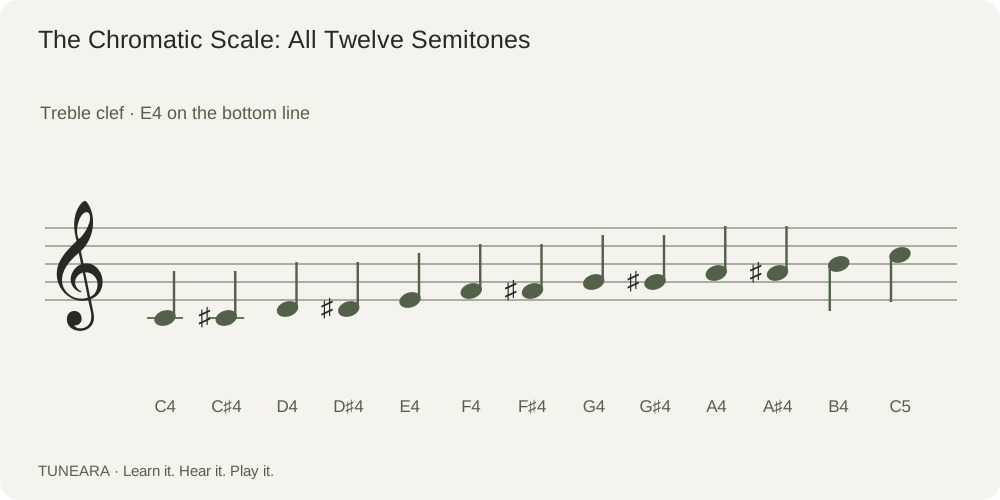
What does chromatic mean?
The chromatic scale includes every semitone within an octave. Starting on C, one common ascending spelling is C, C♯, D, D♯, E, F, F♯, G, G♯, A, A♯, B, then C again. Some pitches have alternative names, such as C♯ and D♭, depending on musical context.
In twelve-tone equal temperament, those alternative names can refer to the same frequency. A tuner may display one spelling by default. Seeing A♯ rather than B♭ does not necessarily mean the instrument is on a different pitch.
Chromatic tuner or instrument preset?
| Mode | Useful when | What you must check |
|---|---|---|
| Instrument preset | Your strings match the supported tuning | Correct instrument and preset |
| Chromatic | You need other notes or tunings | Target note, octave and reference |
A preset can reduce confusion by keeping the standard string targets visible. A chromatic display offers flexibility, but the nearest note is not automatically the note you wanted. A badly flat E string may appear closer to E♭; centering E♭ would leave it a semitone below E.
How to use a chromatic tuner
- Write down the correct open-string targets or the note you want to check.
- Play one steady note in a quiet space.
- Confirm the displayed note name and octave before reading the cents indicator.
- Adjust gradually toward the intended note, then center the pitch reading.
- Repeat and listen to the instrument as a whole.
For common string setups, use the standard tuning chart. If “flat,” “sharp” and “cents” are unfamiliar, start with what being in tune means.
Example: tuning a guitar to drop D
In drop D, the guitar’s lowest open string changes from E2 to D2. The other open strings remain A2–D3–G3–B3–E4. A chromatic tuner can show the D target directly, even if a standard guitar preset expects the lowest string to be E.
Lower the sixth string gradually and check the octave. Do not confuse D2 on the lowest string with D3 on the fourth string. The tuner helps you match a target; the tuning plan tells you which target is correct.
What a chromatic tuner cannot tell you
A chromatic label does not guarantee accurate detection across every instrument’s full range. Microphone quality, background noise, strong harmonics and how the note is played all affect the reading. Test the notes you actually use.
It also does not diagnose instrument setup or choose an ensemble’s tuning reference. Use it as a useful measurement, alongside listening and appropriate instrument guidance.
Tuneara offers chromatic tuning alongside instrument presets. Our tuner app selection guide explains the other things worth evaluating.
References and further learning

Get Tuneara
Your next practice
starts here.
A free tuner and metronome for iPhone and Android.