What Does “In Tune” Mean? Pitch, Frequency & Cents
← Back to Instrument tuning guides
An instrument is in tune when its notes match the intended pitches closely enough for the musical setting. A tuner compares a detected pitch with a reference and shows whether it is below the target, above it, or close to the center.
Pitch and frequency: what is the difference?
Pitch is how high or low a sound seems. Frequency measures how often a vibration repeats, in hertz (Hz). For a steady musical tone, a higher fundamental frequency generally means a higher pitch. Timbre is different: it is why a violin and a guitar still sound different when playing the same note.
A common modern reference is A4 at 440 Hz. In twelve-tone equal temperament, doubling that frequency gives A5 at 880 Hz, an octave higher. Other reference pitches are used in some ensembles; agree on the reference before tuning together.
What are cents on a tuner?
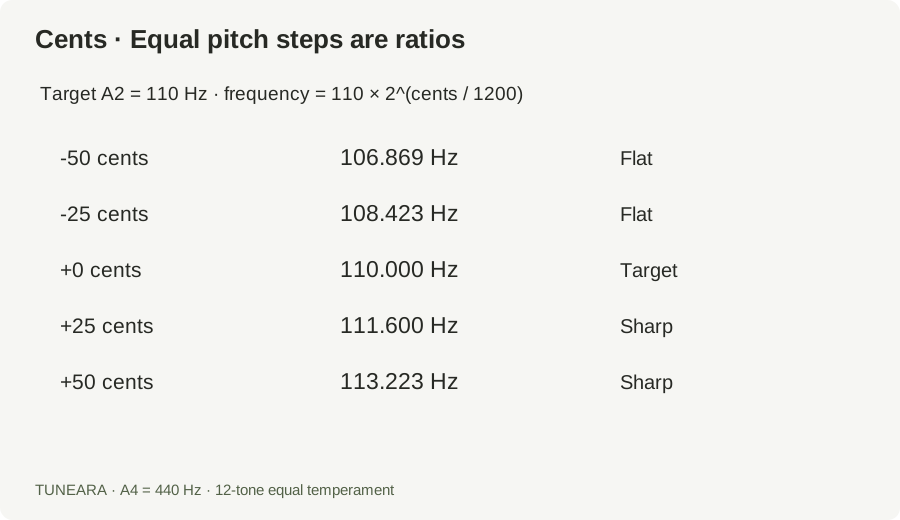
A cent is a small unit of pitch distance. In equal temperament, one semitone spans 100 cents, and an octave spans 1,200 cents. Cents describe a ratio between frequencies, not a fixed number of hertz.
| Reading | Meaning | Adjustment |
|---|---|---|
| −20 cents | Below the target: flat | Raise the pitch slightly |
| 0 cents | At the reference pitch | Check that it settles |
| +20 cents | Above the target: sharp | Lower the pitch slightly |
For example, A4 at about 442.55 Hz is roughly 10 cents above A4 at 440 Hz. You can calculate the difference with 1,200 × log₂(measured frequency ÷ target frequency). The same hertz difference represents a larger cents difference at lower pitches.
How to bring a string into tune
Start with the correct target note and octave. Play a single open string at a moderate volume, let the initial attack settle, and make a small adjustment. Check again after each change. A reading near zero is useful only if you are tuning to the right note.
Use our standard instrument tuning chart to check the notes first. If you need a note outside a preset, a chromatic tuner can show the nearest note across the scale.
Why does the reading move?
A real string does not produce a perfectly unchanging tone. Its pitch can shift after the attack, while vibrato, nearby sounds and strong harmonics can make detection less stable. Avoid turning the peg continuously to chase every movement. Let the sound settle, damp other strings and check a fresh note.
On a fretted instrument, an open string can be tuned correctly while fretted notes are still sharp or flat because of technique or setup. That is an intonation question, not proof that the tuner is wrong. If the problem persists, ask a teacher or instrument technician to help you assess it.
Does every note need to read exactly zero?
No single visual tolerance suits every instrument and musical setting. A tuner gives a reference; your ears still matter. Instruments with flexible pitch may adjust intervals while playing with others. Use a consistent starting point, listen to the ensemble, and avoid treating a flickering display as a score for your musicianship.
Tuneara’s instrument tuner gives direct pitch guidance. To choose the right kind of tool, see what makes a good tuner app.
References and further learning

Get Tuneara
Your next practice
starts here.
A free tuner and metronome for iPhone and Android.