Standard Tuning Notes: Guitar, Bass, Violin & Ukulele
← Back to Instrument tuning guides
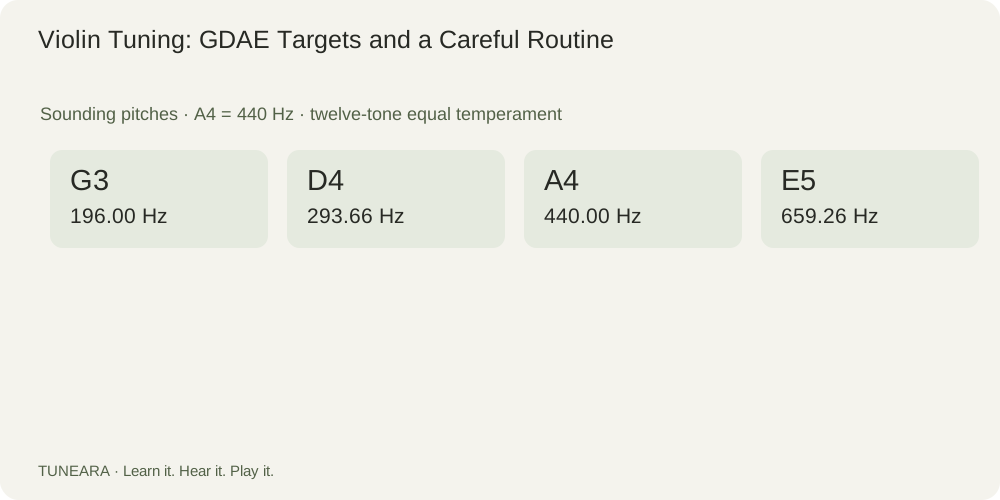
Standard guitar tuning is E2–A2–D3–G3–B3–E4; four-string bass is E1–A1–D2–G2; violin is G3–D4–A4–E5. A common high-G ukulele tuning is G4–C4–E4–A4 in fourth-to-first string order. Check the octave as well as the note name.
Standard tuning chart
The numbers below use scientific pitch notation, where middle C is C4. For guitar, bass and violin, notes are listed from lowest-pitched open string to highest. Ukulele is listed from fourth string to first; its high-G version is not in ascending pitch order.
| Instrument | Notes | String order |
|---|---|---|
| Six-string guitar | E2 A2 D3 G3 B3 E4 | 6 → 1 |
| Four-string bass | E1 A1 D2 G2 | 4 → 1 |
| Violin | G3 D4 A4 E5 | 4 → 1 |
| High-G ukulele | G4 C4 E4 A4 | 4 → 1 |
| Low-G ukulele | G3 C4 E4 A4 | 4 → 1 |
Why the octave number matters
Two notes can have the same letter name while being an octave apart. A guitar’s lowest and highest open strings are both E, but they are E2 and E4, two octaves apart. Matching the letter alone is not enough.
A tuner can sometimes follow a strong harmonic rather than the fundamental. If a low string appears an octave high, damp nearby strings and play again before tightening it. Do not keep increasing tension simply to force a display into a particular octave.
Our guide to pitch, frequency and cents explains what the numbers on a tuner actually mean.
High-G and low-G ukulele tuning
Many soprano, concert and tenor ukuleles use re-entrant high-G tuning. The fourth string, G4, is higher than the neighboring C4 and E4 strings. Low-G tuning replaces it with G3, giving an ascending sequence from the fourth string to the first.
Use strings intended for the tuning and instrument. Changing high G to low G is not simply a matter of loosening every existing string. Baritone ukuleles commonly use D3–G3–B3–E4, so do not assume every ukulele matches the G–C–E–A chart.
Use the chart with a tuner
- Confirm the instrument, string number and intended tuning.
- Select the matching instrument preset, or use a chromatic tuner with the target notes beside you.
- Play one open string and allow the initial attack to settle.
- Adjust in small steps, then check all strings again.
If the instrument is far from pitch, you are unsure which peg controls a string, or a violin peg is difficult to move, ask a teacher or technician for help. Avoid forcing pegs or adding large amounts of tension.
What about alternate tunings?
These are common starting points, not the only valid tunings. A five-string bass, an alternate guitar tuning or a different instrument needs a different target list. Work from a reliable tuning reference for that exact setup.
A chromatic tuner can read notes outside a standard preset, but it cannot decide which notes your strings should use. Tuneara includes instrument modes and chromatic tuning; see how to choose a tuner app for the practical differences.
References and further learning

Get Tuneara
Your next practice
starts here.
A free tuner and metronome for iPhone and Android.