Dotted Notes: Add Half the Original Value
A dot after a note or rest adds half its original duration. A dotted quarter equals three eighth notes, and a dotted half equals three quarter notes.
How to calculate dotted note values
The dot is a duration modifier, not an accent or a separate note. Calculate from the unmodified value: quarter plus eighth gives a dotted quarter. A second dot adds half of the first dot’s added value, so a double-dotted quarter equals seven sixteenth notes. Begin with one dot before tackling two.
Count a dotted quarter followed by an eighth
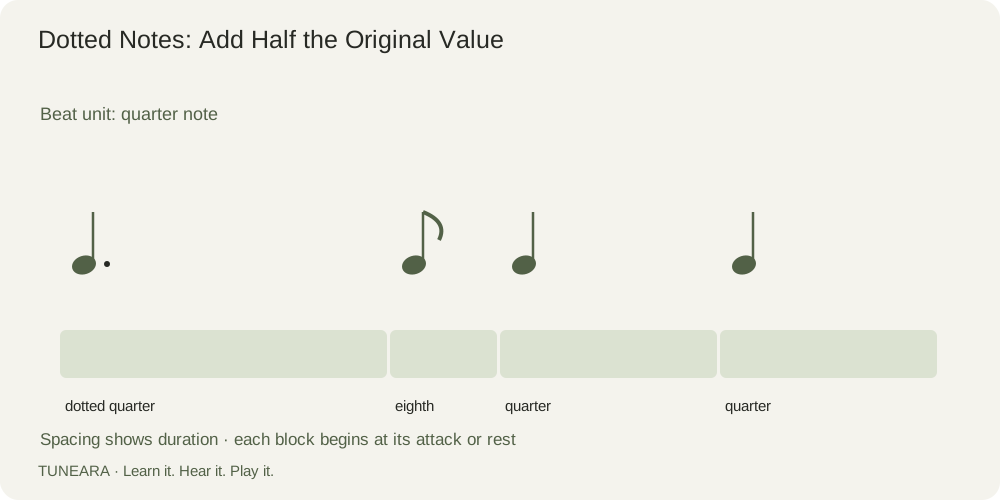
In 4/4, a dotted quarter followed by an eighth occupies two beats. Count “1 and 2 and”: the dotted quarter starts on 1, lasts through the beginning of 2, and the eighth begins on the “and” after 2. In common 6/8, a dotted quarter often represents one main beat.
Try it in practice
Clap a dotted quarter and an eighth, then two quarter notes to fill a 4/4 measure. Speak all eighth subdivisions while sustaining the first sound. Repeat the two-beat dotted-quarter/eighth pair several times without shortening the long note. Compare it with two equal quarters so the uneven spacing is clear.
Avoid a common mistake
Do not add a fixed half beat to every dotted value. A dotted half adds a full quarter, while a dotted eighth adds a sixteenth. The dot scales with the original note. Also check meter: dotted-quarter motion can be the regular pulse in compound meter rather than an unusual syncopation.
Read the visual example
What to learn next
Connect this lesson to Treble Clef Notes: Lines, Spaces, and Landmarks, then try Note Values: Whole, Half, Quarter, and Eighth Notes.
References and further learning

Get Tuneara
Your next practice
starts here.
A free tuner and metronome for iPhone and Android.