Enharmonic Notes: Why C-sharp and D-flat Can Match
Enharmonic names spell a pitch differently, such as C-sharp and D-flat. In twelve-tone equal temperament they share a frequency, but their written roles can differ.
Why the same pitch can have different note names
A letter name records a note’s place in a scale or chord. An accidental modifies that letter. C-sharp rises from C, while D-flat lowers D. On an equal-tempered keyboard they point to the same key, but the spellings can communicate different voice-leading or harmonic functions.
Spell D major with C-sharp rather than D-flat
D major is D–E–F-sharp–G–A–B–C-sharp. Calling the last note D-flat would repeat D and omit C from the seven-letter scale pattern. In an A major chord, A–C-sharp–E spells a third above A correctly; A–D-flat–E would describe a different written interval structure.
Try it in practice
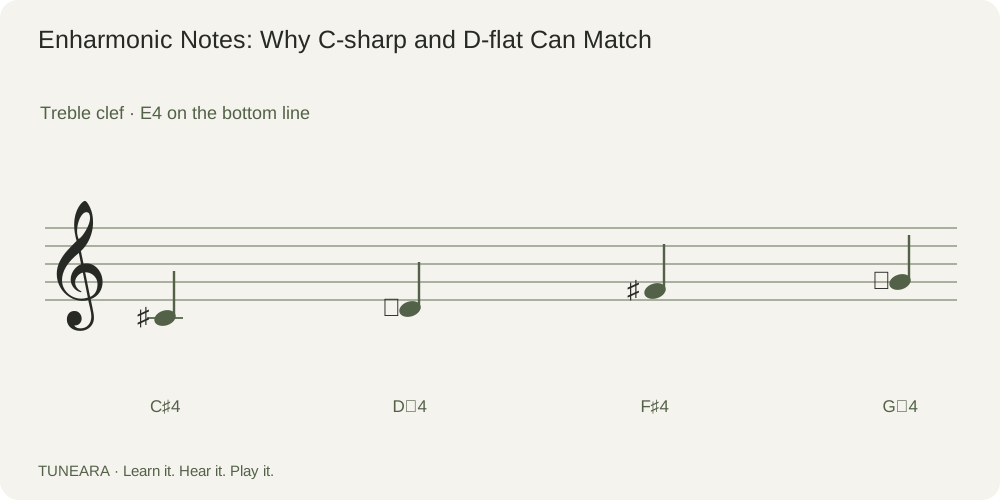
Play C-sharp4 and D-flat4 on the same keyboard key, then write each on a treble staff. Notice that the notehead shifts from a C position to a D position even though the sounding target stays the same. Next, spell D major using each letter exactly once.
Avoid a common mistake
Equal frequency does not make every spelling equally useful in every passage. Tuner displays often choose a default sharp or flat spelling without analyzing the musical key. Other tuning systems and expressive ensemble practice can treat enharmonic notes differently, so keep the equal-temperament assumption attached to the frequency claim.
Read the visual example
What to learn next
Connect this lesson to Treble Clef Notes: Lines, Spaces, and Landmarks, then try Note Values: Whole, Half, Quarter, and Eighth Notes.
References and further learning

Get Tuneara
Your next practice
starts here.
A free tuner and metronome for iPhone and Android.