The Grand Staff: Connect Treble and Bass Clefs
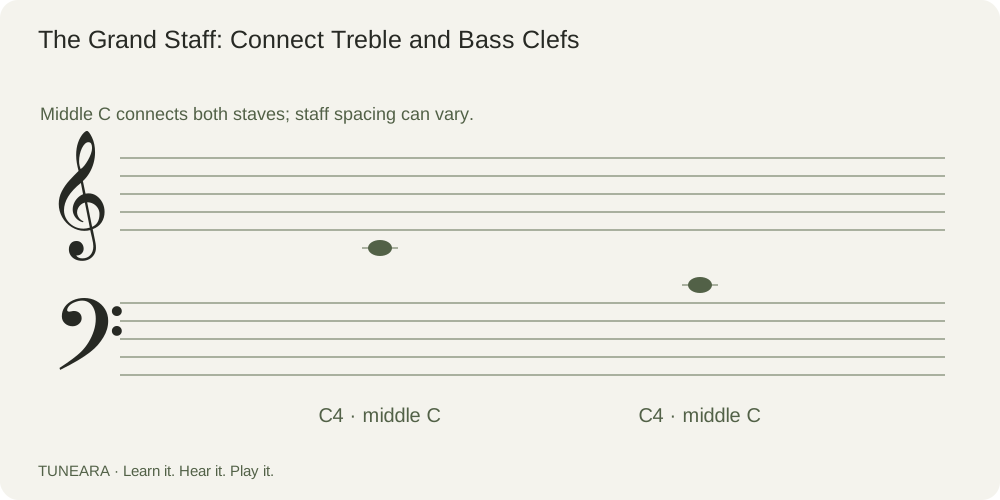
The grand staff joins treble and bass staves for a wider written range. Middle C, C4, connects them: it sits below treble clef and above bass clef.
How treble and bass clefs form the grand staff
A brace groups the two staves, and aligned barlines show their shared measure boundaries. Notes that line up vertically normally occur together. Keyboard music often places higher material above and lower material below, but the staves do not permanently assign each note to a particular hand.
Find middle C between the two staves
Picture C4 between the staves. Above it come D4 and E4, the bottom treble line. Below it come B3 and A3, the top bass line. The vertical gap between the printed staves can vary without changing those pitch relationships. Spacing is for readability, not a new interval.
Try it in practice
Find C4 on your instrument, then play B3–C4–D4. Write or point to each note on the appropriate staff. Next, read a bass C3 and a treble C5 together as two octaves apart. Check both registers; matching only the letter names would hide the distance between them.
Avoid a common mistake
Do not count the blank printed gap as a fixed number of extra staff spaces. Follow ledger lines and the clef. Cross-staff notation may also move a musical line between the two staves without changing which hand plays it. Learn the pitches first, then use the score’s fingering or a teacher’s guidance for hand allocation.
Read the visual example
What to learn next
Connect this lesson to Treble Clef Notes: Lines, Spaces, and Landmarks, then try Note Values: Whole, Half, Quarter, and Eighth Notes.
References and further learning

Get Tuneara
Your next practice
starts here.
A free tuner and metronome for iPhone and Android.