Key Signatures: Read the Sharps or Flats at the Start
A key signature sets recurring sharps or flats for their letter names across octaves. It suggests a pitch collection, but does not by itself prove the music’s tonic.
Read the order of sharps and flats
The signature sits after the clef and before the time signature at the start of a staff. Sharp signatures follow F–C–G–D–A–E–B; flat signatures follow B–E–A–D–G–C–F. Each affected letter keeps its alteration unless a local accidental changes it. A new key signature changes that background collection.
Compare G major and E minor under one signature
One sharp, F-sharp, belongs to G major and its relative E minor. Two flats, B-flat and E-flat, belong to B-flat major and G minor. To decide which tonic is active, listen to phrase endings and harmony instead of guessing only from the number of symbols.
Try it in practice
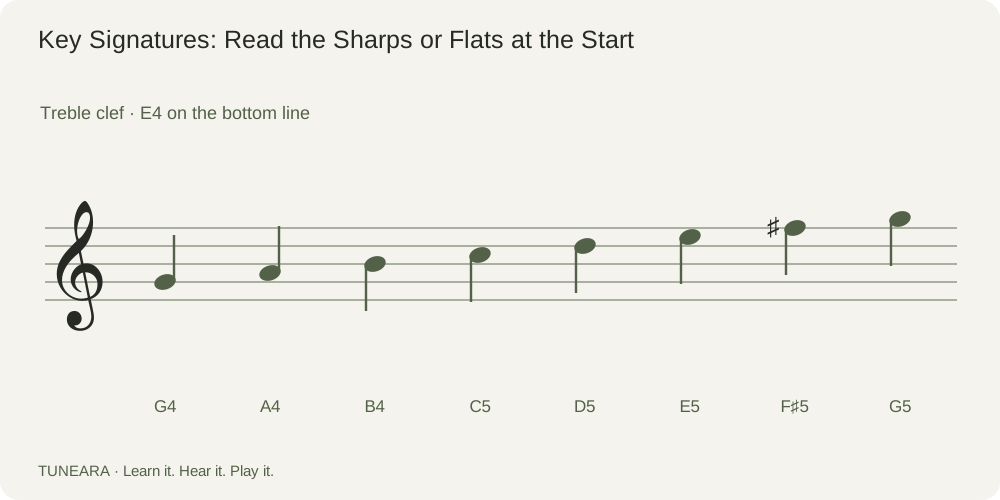
Read a G-major collection: G–A–B–C–D–E–F-sharp–G. Mark every F in a short practice melody before playing it. Then try E natural minor using the same signature. Notice how starting points and phrase emphasis can change your sense of home without changing the written key signature.
Avoid a common mistake
An F-sharp in the key signature applies to F in every octave; a typical measure accidental is more locally scoped. Do not confuse those two rules. Music can also use notes outside its signature, change keys, or center on a mode. Use the signature as a reading aid rather than a complete harmonic analysis.
Read the visual example
What to learn next
Connect this lesson to Treble Clef Notes: Lines, Spaces, and Landmarks, then try Note Values: Whole, Half, Quarter, and Eighth Notes.
References and further learning

Get Tuneara
Your next practice
starts here.
A free tuner and metronome for iPhone and Android.

