Ledger Lines: Read Notes Above and Below the Staff
Ledger lines extend a staff with short extra lines. Count lines and spaces from a known staff note to identify the pitch, keeping the clef in view.
How ledger lines extend the staff
The letter sequence continues beyond the five main lines without changing its rules. A ledger line is only long enough to support the notehead and nearby spacing. A note can also sit in a space between ledger lines. Counting only the drawn lines skips half of the available note positions.
Find C4 below and A5 above treble clef
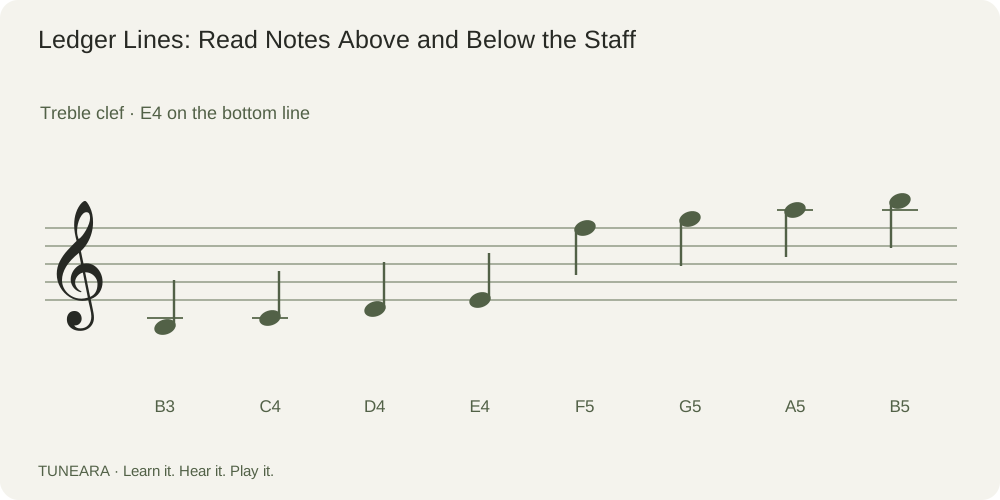
In treble clef, the bottom line is E4. The space below it is D4, the first ledger line below is C4, and the next space is B3. Above the top F5 line, the next space is G5 and the first ledger line is A5. Those landmarks make nearby notes quicker to recognize.
Try it in practice
Locate C4 and A5 in the chart, then identify one neighboring note on either side of each. Read a four-note pattern that enters and leaves the staff rather than isolating only extreme notes. Play it slowly, checking whether the direction you hear matches the direction written on the page.
Avoid a common mistake
A note on a ledger line is different from one just above it. Inspect the center of the notehead rather than the stem. For passages with many ledger lines, a score may change clef or use an octave marking; read those instructions before counting every note from a distant landmark.
Read the visual example
What to learn next
Connect this lesson to Treble Clef Notes: Lines, Spaces, and Landmarks, then try Note Values: Whole, Half, Quarter, and Eighth Notes.
References and further learning

Get Tuneara
Your next practice
starts here.
A free tuner and metronome for iPhone and Android.