Octave Numbers: Tell C4, C5, and Pitch Classes Apart
In scientific pitch notation, a number identifies a note’s register. Middle C is C4, and the octave number increases when the pitch crosses from B to C.
How scientific pitch notation names an octave
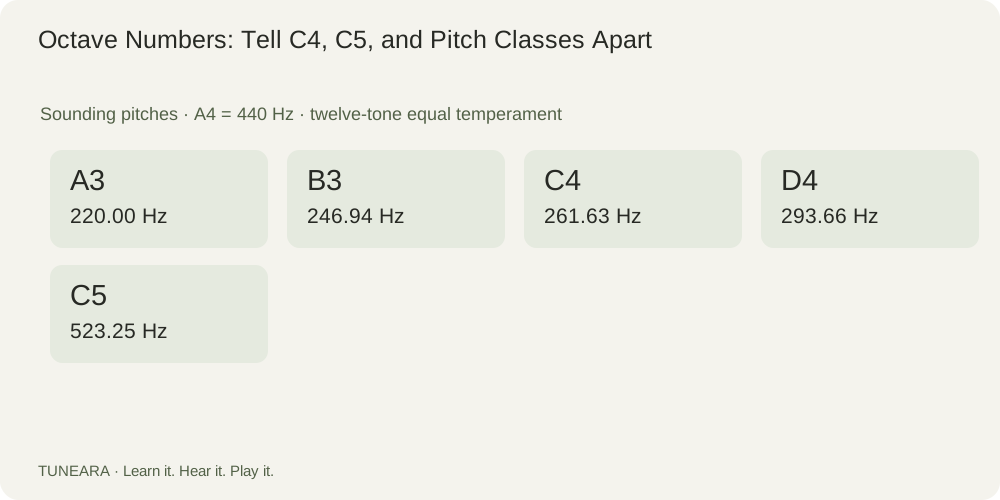
The number is not a string number, fingering, or harmonic number. C4 and C5 share the pitch class C but differ by an octave. In equal temperament, the higher octave has twice the frequency. A4 commonly uses 440 Hz, while A3 uses 220 Hz at that same reference.
Follow octave numbers across the B-to-C boundary
The sequence near middle C is A3, B3, C4, D4. G-sharp4 remains in octave 4; moving up to A4 does not change the octave number. Guitar’s low E2 and high E4 differ by two octaves even though both are open E strings. A letter-only tuner can hide this distinction.
Try it in practice
Find C4, play or sing a comfortable octave above it, then return. Write C4–C5 beside the two sounds. Next, label B3–C4 and B4–C5 to practice where the register number changes. Use a known instrument reference instead of tightening a string solely to satisfy an unexpected octave reading.
Avoid a common mistake
Some software uses a different numbering convention for middle C. Confirm the convention before comparing screens. Conventional guitar and bass staff notation also sounds an octave below its written pitch. Keep written-note labels, sounding-frequency labels, and MIDI values clearly identified rather than treating every number as interchangeable.
Read the visual example
What to learn next
Connect this lesson to Treble Clef Notes: Lines, Spaces, and Landmarks, then try Note Values: Whole, Half, Quarter, and Eighth Notes.
References and further learning

Get Tuneara
Your next practice
starts here.
A free tuner and metronome for iPhone and Android.