Sharps, Flats, and Naturals: Read Accidentals
A sharp raises a written letter by a semitone, a flat lowers it by a semitone, and a natural cancels an applicable sharp or flat.
How sharps, flats, and naturals change a note
An accidental changes the pitch named by the notehead; it does not move the notehead to a different letter position. F-sharp is still written on an F line or space. In ordinary modern notation, a measure accidental normally applies to that same letter and octave for the rest of the measure, unless another accidental changes it.
Read accidentals in a written passage
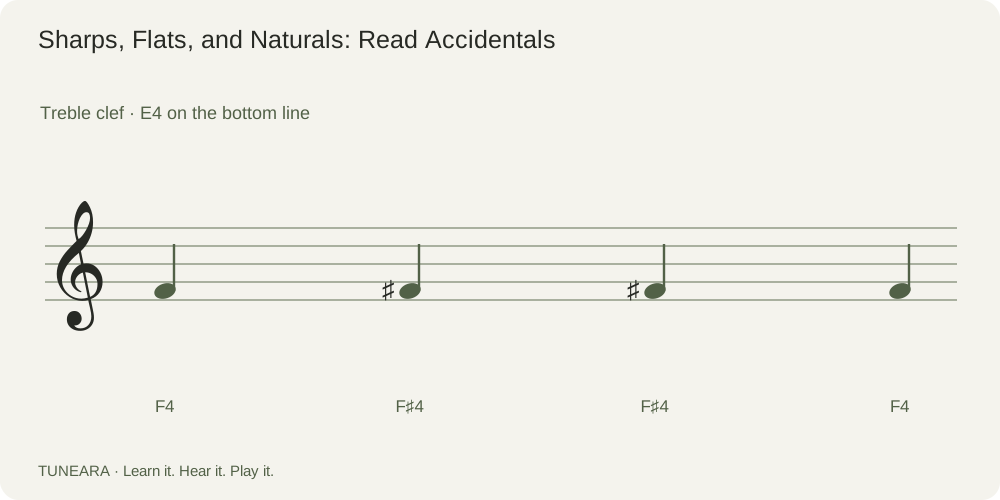
In C major, an F-sharp before F4 changes that note from F4 to F-sharp4. Another F4 later in the measure normally keeps the sharp. At the next barline, the key signature applies again. A tied continuation keeps its original pitch across the barline; a new untied note follows the new measure’s rules.
Try it in practice
Write four F4 notes in one measure. Put a sharp before the first and a natural before the third. Name the result: F-sharp, F-sharp, F natural, F natural. Play the sequence, then place a barline after it and check what the key signature would require in the next measure.
Avoid a common mistake
Do not interpret a natural as “always a white key regardless of context” without identifying the letter; it restores that letter’s natural form. Courtesy accidentals may repeat a sign to help readers even when the rule already implies it. Always inspect key signatures, barlines, and ties before deciding what a symbol cancels.
Read the visual example
What to learn next
Connect this lesson to Treble Clef Notes: Lines, Spaces, and Landmarks, then try Note Values: Whole, Half, Quarter, and Eighth Notes.
References and further learning

Get Tuneara
Your next practice
starts here.
A free tuner and metronome for iPhone and Android.