Ties vs. Slurs: Duration and Phrasing
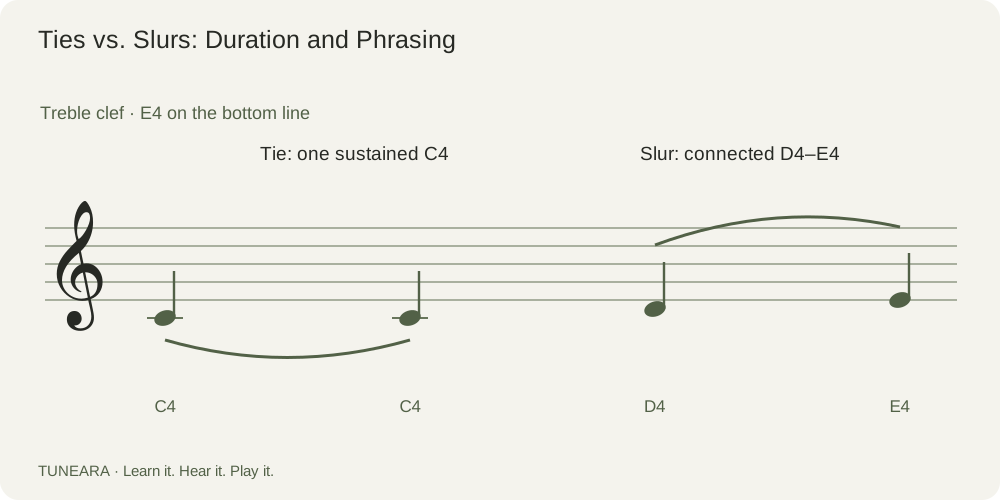
A tie joins consecutive notes of the same pitch into one sustained duration. A slur groups notes for connected phrasing and can join different pitches.
How to tell a tie from a slur
The curved shapes can look similar, so inspect their endpoints. A tie extends a specific pitch across two written values without a new attack. A slur describes a phrase or articulation connection; its precise performance depends on the instrument and style. Neither curve changes a written pitch by itself.
Compare tied C notes with a slurred C–D–E phrase
Two quarter-note C4s tied together last as long as a half note, with one attack. A slur over C4–D4–E4 keeps three distinct pitches. On a wind instrument it may indicate connected notes without separate tonguing; on strings it often relates to bowing. Follow instrument-specific conventions.
Try it in practice
Play C4 for two beats using one attack, then play C4–D4 as two connected one-beat notes. Write the first as tied quarters and the second under a slur. Say “hold” at the second tied head, and “change” at the second slurred head to remind yourself of the difference.
Avoid a common mistake
Do not reattack the second tied note merely because a new notehead appears. Ties frequently cross barlines to preserve the meter’s readable grouping. An accidental attached to the tied pitch continues through its tied duration; a later untied note requires a fresh check of the measure and key-signature rules.
Read the visual example
What to learn next
Connect this lesson to Treble Clef Notes: Lines, Spaces, and Landmarks, then try Note Values: Whole, Half, Quarter, and Eighth Notes.
References and further learning

Get Tuneara
Your next practice
starts here.
A free tuner and metronome for iPhone and Android.