Whole Steps and Half Steps: Count Musical Distance
A half step is one semitone; a whole step is two semitones. On a guitar they span one and two frets; on a keyboard count adjacent keys, including black keys.
Whole steps, half steps, and natural note pairs
Half steps describe the twelve equal pitch steps of an octave in equal temperament. Whole steps combine two of them. Natural letter names do not all lie a whole step apart: E–F and B–C are half steps, while C–D is a whole step. The pattern matters when building scales.
Compare C–C-sharp, C–D, and E–F
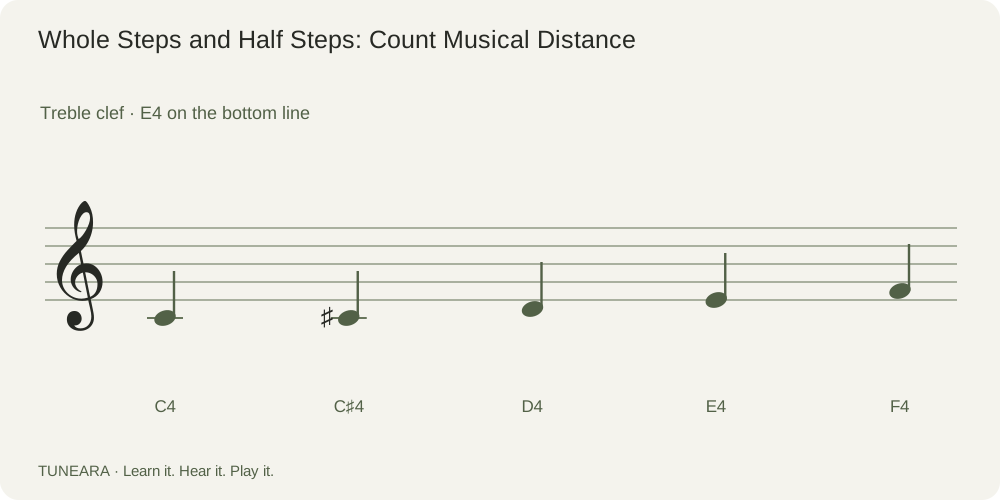
C4 to C-sharp4 is a half step. C4 to D4 is a whole step, passing over C-sharp4. E4 to F4 is already a half step even though neither name needs an accidental. The gap in physical spacing between keyboard keys is not a reliable way to measure the interval.
Try it in practice
Choose C4 and play one half step upward, return, then play one whole step upward. Repeat from E4 and B3. Say every intermediate pitch when counting whole steps. On guitar, use one string so that a single fret always represents a single semitone and string-tuning changes cannot confuse the comparison.
Avoid a common mistake
Do not count only white keys or only changes of letter. C to D-flat is one semitone despite the two letters; C to C-sharp also has a one-semitone sound while keeping the same letter. For named intervals, letter distance and semitone distance both matter. This guide addresses the semitone count first.
Read the visual example
What to learn next
Connect this lesson to Treble Clef Notes: Lines, Spaces, and Landmarks, then try Note Values: Whole, Half, Quarter, and Eighth Notes.
References and further learning

Get Tuneara
Your next practice
starts here.
A free tuner and metronome for iPhone and Android.