How to Tune a Four-String Bass: EADG and Octaves
← Back to Instrument tuning guides
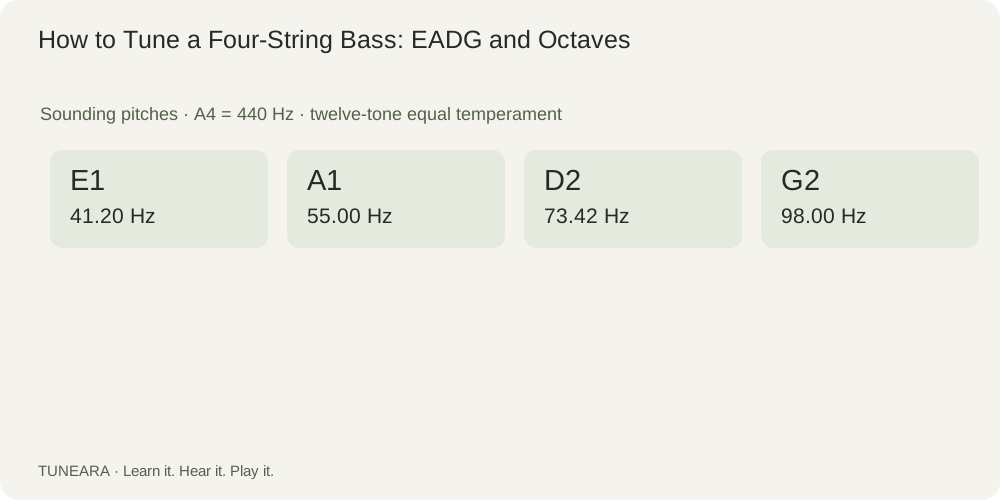
Standard four-string bass tuning is E1–A1–D2–G2, from string 4 to string 1. Confirm the low octave as well as the note name before adjusting tension.
How to tune low bass notes reliably
Bass targets sit one octave below the lowest four standard-guitar strings. A tuner must detect the low range reliably, and microphone detection can follow a stronger harmonic instead of the fundamental. Mute other strings, pluck moderately, and let the sound settle before making a small correction.
Check E1, A1, D2, and G2 frequencies
Low E1 is about 41.20 Hz at A4 = 440 Hz; A1 is 55.00 Hz, D2 about 73.42 Hz, and G2 about 98.00 Hz. Conventional bass notation normally sounds an octave below written pitch, so a staff label and a sounding-frequency chart can appear to disagree unless their conventions are stated.
Try it in practice
Tune one open string at a time from the low E upward, then repeat the set. Compare the fifth fret of E with open A, then the fifth fret of A with open D. Check those comparisons with light pressure so fretting does not create a misleading sharp reference.
Avoid a common mistake
Do not tighten a low E to E2 just because the display locks onto that octave. Check the sound and target first. Five-string basses commonly add B0 below E1, but other layouts exist; use the exact setup for your instrument instead of assuming that any “bass” preset covers every string count.
Read the visual example
What to learn next
Connect this lesson to pitch, frequency, and cents, then try standard instrument targets.
References and further learning

Get Tuneara
Your next practice
starts here.
A free tuner and metronome for iPhone and Android.