The Minor Blues Scale: Add the Flat Fifth
← Back to Music scales and keys
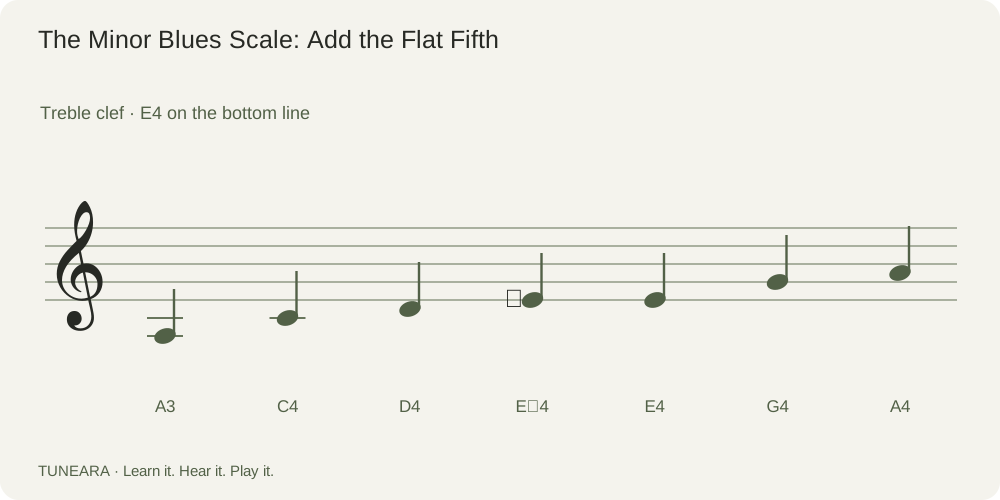
The common minor blues scale adds a flat fifth to minor pentatonic: 1, flat 3, 4, flat 5, 5, flat 7. In A: A, C, D, E-flat, E, G.
How the flat fifth changes minor pentatonic
The added pitch creates a close connection between the fourth and fifth. It is often used as a passing or expressive tone, but its timing and treatment depend on style. Blues pitch practice also includes bends, inflections, and major-minor mixtures that a fixed six-note diagram cannot fully represent.
Add E-flat to the A minor pentatonic scale
From A minor pentatonic, insert E-flat between D and E. Try A–C–D–E-flat–E, then return through D–C–A. The written E-flat is a flat fifth relative to A; a tuner might show D-sharp at the same equal-tempered frequency without explaining its melodic function.
Try it in practice
Play D–E-flat–E slowly over an A reference. First give each note equal duration; next make E-flat a brief connecting note and hold E. Listen for the different effect. Build a short phrase that resolves to A rather than repeatedly racing up and down all six pitches.
Avoid a common mistake
Do not call the scale a complete formula for authentic blues phrasing. Articulation, rhythm, and the harmony underneath matter. Also distinguish the minor blues collection here from other collections sometimes called “major blues scales.” State both the root and the exact degrees when sharing a lesson.
Read the visual example
What to learn next
Connect this lesson to Whole Steps and Half Steps: Count Musical Distance, then try Scale Degrees: Name Notes by Their Role in a Key.
References and further learning

Get Tuneara
Your next practice
starts here.
A free tuner and metronome for iPhone and Android.