Scale Degrees: Name Notes by Their Role in a Key
← Back to Music scales and keys
Scale degrees number notes relative to a tonic. In C major, C is 1, D is 2, E is 3, and the next C is 1 in a higher octave.
How scale degrees number notes from the tonic
Degree numbers describe a pitch’s relationship to the key, rather than a fingering or an absolute letter. They make melodies portable between keys. The tonic is degree 1, the dominant is 5, and the leading tone in major is 7. Altered degrees can be marked with flats or sharps relative to the stated reference scale.
Name a note pattern by degree rather than fixed pitch
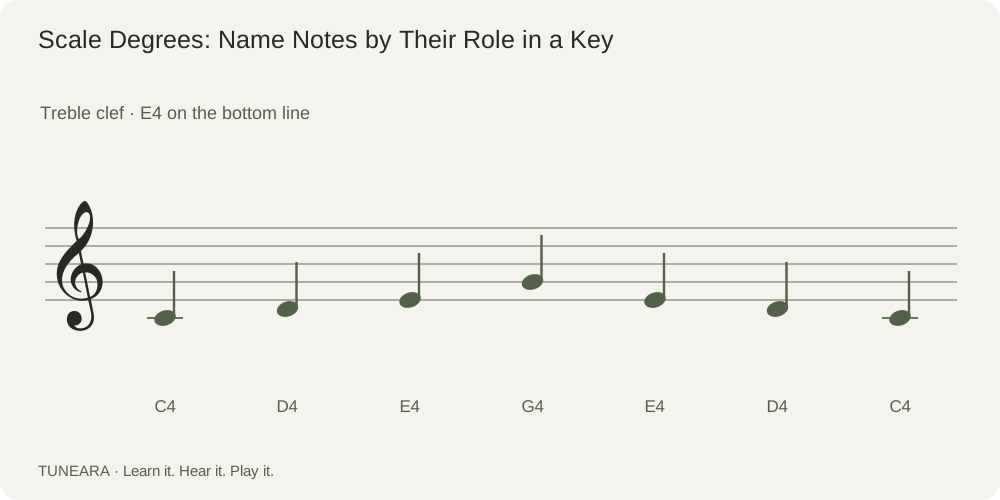
The melody C–D–E–G–E–D–C becomes 1–2–3–5–3–2–1 in C major. In G major, that same degree pattern gives G–A–B–D–B–A–G. The notes change, but their structural relationships remain. Specify whether you are using major-reference alterations or a minor scale’s own numbering.
Try it in practice
Play 1–3–5–3–1 in C major and sing the tonic before beginning. Move to G major and rebuild the same degree pattern from G. Then identify the degrees of a three-note phrase you already know. End on different degrees to hear which endings feel more or less settled in your chosen harmony.
Avoid a common mistake
Do not assume “3” always means E. Its letter depends on the tonic and scale. Also separate scale degrees from Roman-numeral chords: degree 5 is a note, while V describes a chord rooted on degree 5 in the relevant harmonic system.
Read the visual example
What to learn next
Connect this lesson to Whole Steps and Half Steps: Count Musical Distance, then try Musical Intervals: Count Letters and Semitones.
References and further learning

Get Tuneara
Your next practice
starts here.
A free tuner and metronome for iPhone and Android.