Musical Intervals: Count Letters and Semitones
← Back to Music scales and keys
An interval describes the distance between two pitches. Its number comes from letter-name distance, and its quality depends on the semitone span and spelling.
Count letters first, then determine interval quality
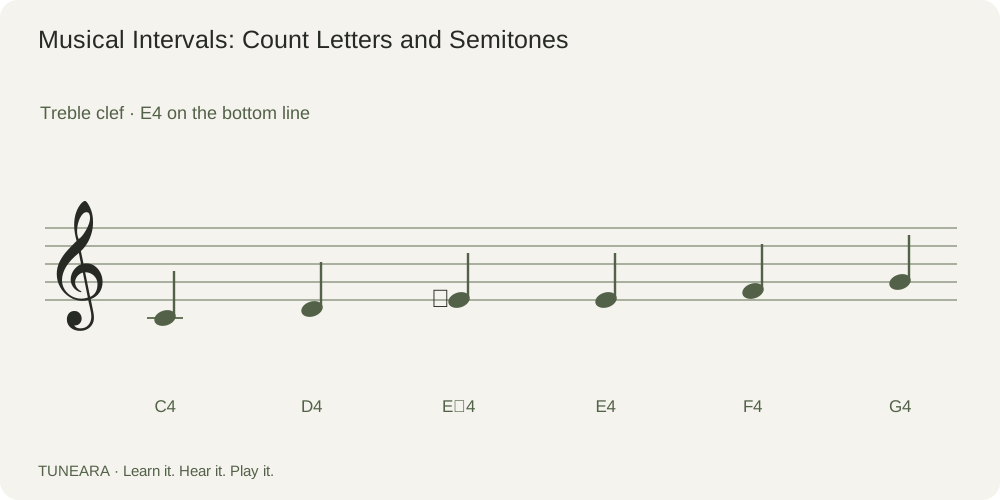
Count both endpoints when finding the interval number: C to E includes C, D, E, so it is some kind of third. Quality specifies which third. C–E is a major third with four semitones; C–E-flat is a minor third with three. The written letters matter as well as the sounding distance.
Compare fourths, fifths, and two tritone spellings
C–F is a perfect fourth, five semitones, and C–G a perfect fifth, seven. C–F-sharp and C–G-flat both span six equal-tempered semitones, but their names differ: augmented fourth and diminished fifth. A tuner can measure distance without telling you which spelling suits the score.
Try it in practice
Write C–D, C–E-flat, C–E, C–F, and C–G. Count letters first, then verify semitone distances on a keyboard. Play each ascending pair and return to C between attempts. For a listening comparison, keep the starting register and instrument tone consistent so those changes do not become accidental clues.
Avoid a common mistake
Do not count only keyboard keys and ignore spelling. Enharmonic intervals can share a sound yet have different names. Also distinguish interval direction and size: descending notes still form intervals, and distances wider than an octave are compound intervals rather than a separate physical pitch system.
Read the visual example
What to learn next
Connect this lesson to Whole Steps and Half Steps: Count Musical Distance, then try Scale Degrees: Name Notes by Their Role in a Key.
References and further learning

Get Tuneara
Your next practice
starts here.
A free tuner and metronome for iPhone and Android.