BPM Explained: Tempo, Beat Length & Practice Speed
BPM means beats per minute. It describes how many reference beats occur in one minute: at 60 BPM each beat lasts one second, and at 120 BPM each beat lasts half a second. The score or exercise determines which note value represents that beat.
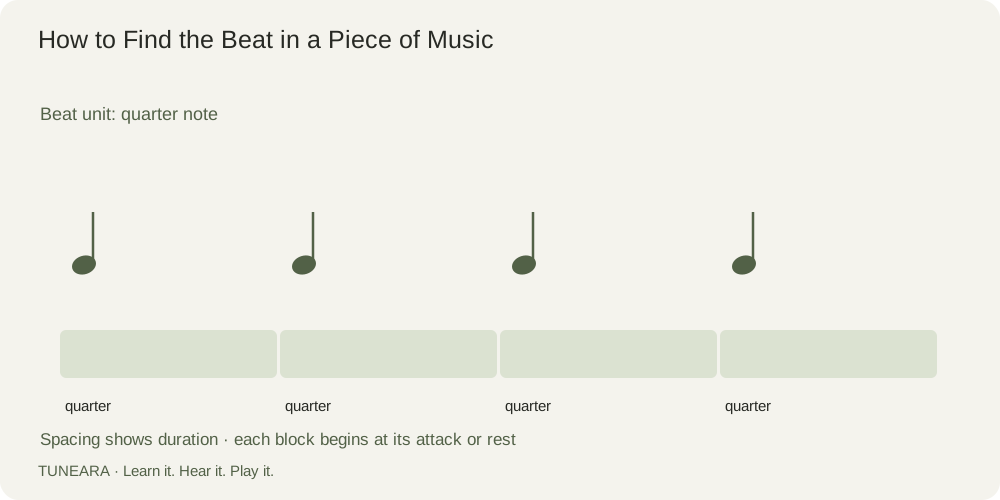
How long is a beat at different tempos?
Divide 60 by the BPM to find the duration of one beat in seconds. This calculation describes the reference pulse. It does not say how many notes fit between clicks or which note value gets the beat.
| Tempo | One beat | Two beats |
|---|---|---|
| 60 BPM | 1 second | 2 seconds |
| 80 BPM | 0.75 seconds | 1.5 seconds |
| 100 BPM | 0.6 seconds | 1.2 seconds |
| 120 BPM | 0.5 seconds | 1 second |
| 150 BPM | 0.4 seconds | 0.8 seconds |
BPM is not the number of notes per minute
At quarter note = 60, you can play one quarter note per second, two even eighth notes per second, or four even sixteenth notes per second. The pulse stays the same while the number of notes changes.
That is why the same BPM can feel easy for a slow melody and demanding for a rapid scale. If an exercise changes from quarter notes to sixteenth notes, keeping the same tempo makes the playing task much faster even though the metronome has not changed.
Check the note value in the tempo marking
A metronome marking pairs a note value with a number. Quarter note = 120 and half note = 120 describe different durations for written quarter notes. In the second case, a written quarter note lasts half a click.
In compound meter, a dotted quarter note may represent the main beat. For example, dotted quarter = 60 in 6/8 gives two main beats per measure. Counting every eighth-note subdivision would require three times that click rate. See how time signatures and beat groupings work.
What BPM should you use for practice?
Choose a speed that lets you perform the actual task with control. A beginner does not need one standard tempo for every exercise. Start with a short phrase, notice where the movement becomes rushed, and adjust from there.
If very slow clicks leave too much space to follow, count subdivisions aloud or choose an exercise with a clearer pulse. Increasing click density can help you feel the spacing without increasing the intended musical tempo.
Follow our metronome practice routine for a concrete way to apply this.
What about words such as allegro or andante?
Tempo words suggest pace and character, but their interpretation depends on the music, period and performer. They are not a substitute for checking the note value in a numerical marking. Avoid treating a single online BPM range as a rigid definition for every piece.
A metronome gives you a repeatable reference while you decide how the phrase should move. If you are choosing an app, consider tempo controls and everyday usability alongside its feature list.
References and further learning

Get Tuneara
Your next practice
starts here.
A free tuner and metronome for iPhone and Android.