How to Practice with a Metronome: A Simple Routine
To practice with a metronome, choose a short passage and a tempo slow enough to play comfortably. Listen and count before you begin, repeat the passage with a steady pulse, and increase the tempo only when the playing feels controlled.
Choose a tempo you can actually play
Start below performance speed. There is no universal beginner BPM: a comfortable tempo depends on the passage, note values, instrument and technique. If you cannot play a short section without stopping, reduce the tempo or simplify the task.
Tempo measures the speed of the pulse, rather than how many notes you play. Read BPM explained if you are unsure what each click represents. For a first exercise, use 4/4 and let each click represent one quarter-note beat.
Listen, count, then play
Listen to at least a measure of clicks before entering. Count “1, 2, 3, 4” with the pulse, and tap or clap along. Then play one comfortable note per click. If that is difficult, keep counting without playing until you can anticipate the next beat.
The goal is to feel where the beat is going, rather than react after hearing each click. Keep your hands relaxed. Use a volume that lets you hear both your instrument and the reference clearly.
Try this ten-minute practice routine
- Minutes 1–2: count and tap the pulse, then play one easy note on each click.
- Minutes 3–5: repeat a short scale or two-measure passage at a comfortable tempo.
- Minutes 6–8: isolate the transition that tends to rush or hesitate. Practice just before and after it.
- Minutes 9–10: play the whole passage again, then try once without the click and notice what changes.
This is a suggested routine, not a required progression. Spend longer on a smaller task if it helps you listen more carefully.
Count the space between clicks
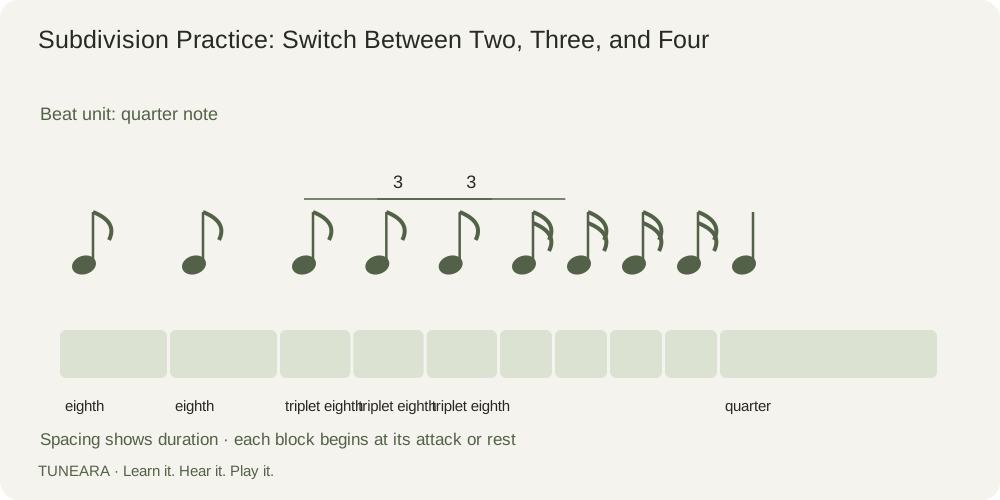
For even eighth notes over quarter-note clicks, count “1 and 2 and 3 and 4 and.” The numbered syllables land on the clicks, and “and” sits halfway between them. Keep the syllables evenly spaced rather than squeezing the offbeats toward the next click.
Not every meter uses that grouping. In a typical 6/8 feel, each of two main beats divides into three. Our time-signature guide explains why six eighth notes do not always mean six main beats.
Build speed without chasing a number
Once you can repeat the passage with even rhythm and comfortable movement, try a small increase, such as 2–5 BPM. That increment is a practice choice, not a rule. If errors, tension or uneven articulation return, step back and work out what changed.
Do not let the click hide musical phrasing. Practice quietly and loudly, listen for note lengths, and include time without the metronome. A steady pulse supports expression; it does not require every phrase to sound mechanical.
You can set a reference pulse with Tuneara’s metronome. For help selecting a tool, see how to choose a metronome app.
References and further learning

Get Tuneara
Your next practice
starts here.
A free tuner and metronome for iPhone and Android.

