Time Signatures Explained: Counting 3/4, 4/4 & 6/8
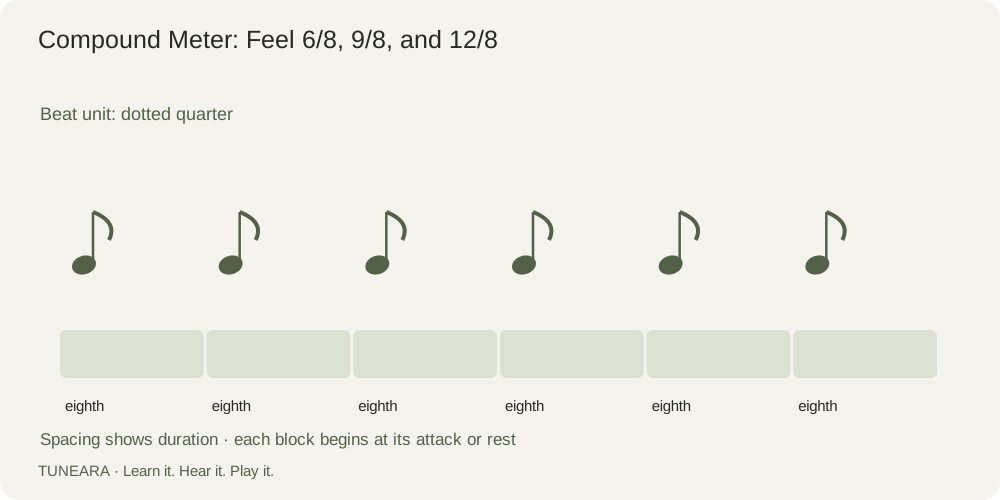
A time signature describes how written note values fit into a measure and helps indicate their grouping. In 4/4 there are four quarter-note units per measure. In a typical 6/8 meter, six eighth notes group into two main beats, each divided into three.
What do the two numbers mean?
The lower number names a written note value: 4 means quarter notes, 8 means eighth notes, and 2 means half notes. The upper number tells you how many of those units fill a measure. That description works for the written capacity of a measure; musical beat grouping needs one more step.
In simple meters such as 3/4 and 4/4, a quarter note usually gets the main beat. In compound meters such as a typical 6/8, the main beat is a group of three eighth notes, or a dotted quarter. The top number therefore does not always equal the number of main beats you feel.
How to count 3/4, 4/4 and 6/8
| Meter | Typical main beats | Count eighth notes |
|---|---|---|
| 3/4 | Three quarter-note beats | 1 and 2 and 3 and |
| 4/4 | Four quarter-note beats | 1 and 2 and 3 and 4 and |
| 6/8 | Two dotted-quarter beats | 1 la li 2 la li |
Counting syllables vary between teachers. What matters here is grouping: pairs within each simple beat, or threes within each compound beat. Speak the count evenly before adding an instrument.
Why 3/4 and 6/8 are different
Both can contain six eighth notes, but the usual grouping differs. In 3/4, think of three pairs: ONE-and TWO-and THREE-and. In 6/8, think of two groups of three: ONE-la-li TWO-la-li.
Try clapping six evenly spaced sounds. First emphasize sounds 1, 3 and 5. Then emphasize only 1 and 4. You have kept the same small-note spacing while changing the main-beat pattern. That distinction is more informative than merely counting to six.
A time signature does not tell you the tempo
You can play 4/4 slowly or quickly. A time signature organizes notes into measures; a tempo marking specifies their pace. Check whether a BPM marking refers to quarter notes, eighth notes or dotted-quarter beats before setting a metronome.
For example, in 6/8 with dotted quarter = 60, the two main beats each last one second. If you want a click on all six eighth-note subdivisions, the click rate is 180 per minute. Read BPM and note values explained for the calculation.
Practice the grouping before the passage
Count one or two measures, clap the subdivisions, and then play a single comfortable note on each main beat. Only add the written rhythm when you can maintain the underlying grouping. Keep the first beat clear without making every note excessively accented.
Use our metronome practice guide to turn that into a short routine. If you need compound-meter support in an app, check how its time signatures and subdivisions work rather than assuming a “6” setting creates the right feel.
References and further learning

Get Tuneara
Your next practice
starts here.
A free tuner and metronome for iPhone and Android.