Cadences: Hear Phrase Endings and Harmonic Arrival
A cadence is a musical phrase ending shaped by harmony, melody, rhythm, and context. Common tonal patterns include V–I, IV–I, and an ending on V.
What makes a chord pattern a cadence?
A chord pair alone does not guarantee a cadence. Placement at the end of a phrase and the music’s accent structure help create arrival. An authentic cadence involves dominant-to-tonic motion, a plagal pattern commonly uses IV–I, and a half cadence stops on dominant. More specific labels consider inversion and melody.
Compare G–C, F–C, G, and G–Am phrase endings
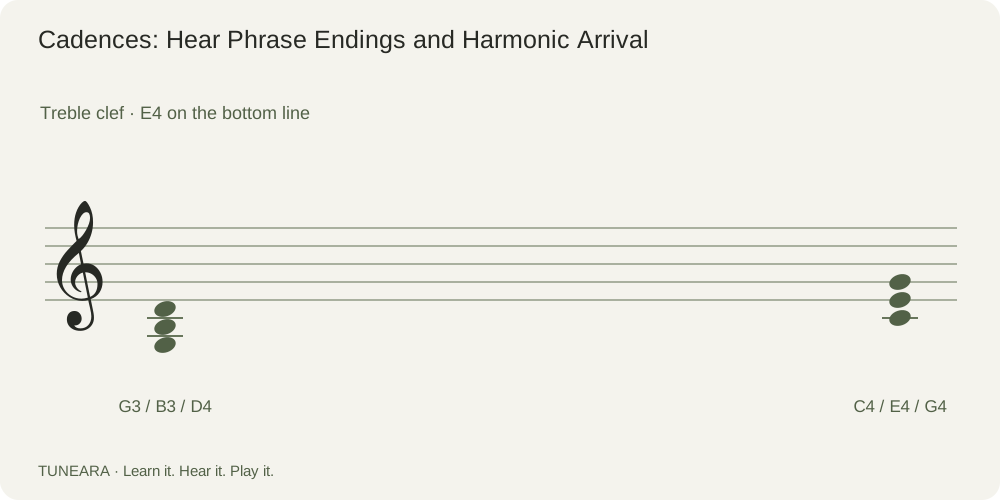
In C major, G–C gives V–I and F–C gives IV–I. A phrase ending on G can feel open because the tonic has not returned. G–Am gives a common deceptive pattern, V–vi, delaying an expected C arrival. The emotional effect still depends on the surrounding musical phrase.
Try it in practice
Create a four-measure phrase ending G–C, then change the last chord to Am. Keep the preceding melody and rhythm similar so the altered harmony is easy to hear. Sing the melody’s final note and identify how it fits each ending. Next, stop on G and leave a breath before continuing.
Avoid a common mistake
Do not label every final tonic chord a perfect authentic cadence. That more specific term has additional requirements in common-practice analysis. Also avoid replacing listening with shorthand: rhythm, bass position, and the final melody note can make two V–I endings feel quite different.
Read the visual example
What to learn next
Connect this lesson to Major Triads: Build Root, Third, and Fifth, then try Minor Triads: Lower the Third, Keep the Fifth.
References and further learning

Get Tuneara
Your next practice
starts here.
A free tuner and metronome for iPhone and Android.

