Chord Symbols: Read Roots, Quality, Extensions, and Bass Notes
A chord symbol names a root and modifies its quality or added members. C, Cm, C7, Cmaj7, and C/E describe different pitch collections or bass choices.
Read the root, chord quality, and slash bass
Begin with the root letter and any accidental attached to it. Then read quality markers: m commonly means minor, maj7 major seventh, and an unqualified 7 a dominant-seventh structure. A slash introduces a bass note. Symbols vary across publishers, so consult an edition’s legend when a sign is unfamiliar.
Compare C, Cm, Csus4, and seventh-chord symbols
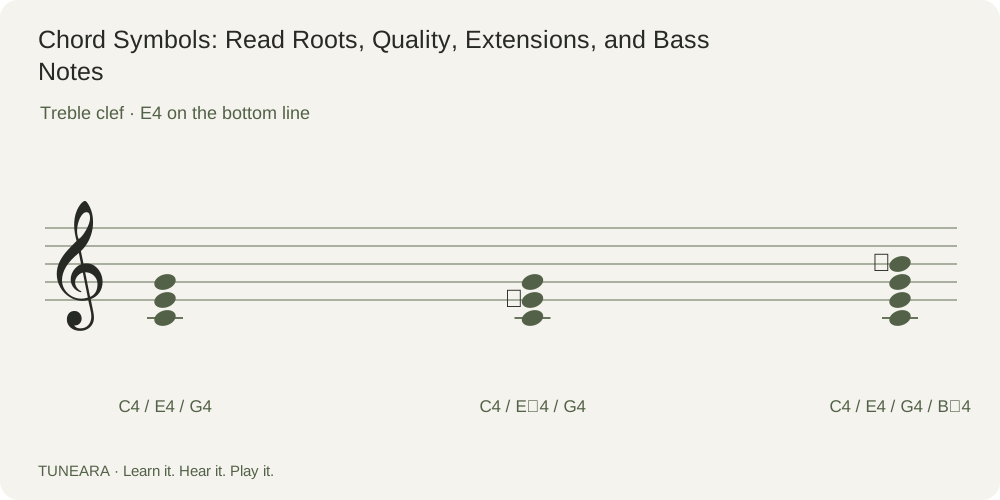
C is C–E–G; Cm is C–E-flat–G; Csus4 replaces the third with F, giving C–F–G. Cadd9 adds D to the triad without requiring a seventh. C9 conventionally includes the dominant seventh as part of its structure. C/E places E in the bass while retaining C-major harmony.
Try it in practice
Write each symbol beside its pitch names, then play a compact voicing. Compare Cadd9 with C9 to hear the seventh’s contribution. Read the root and bass aloud for C/E and C/G. If you play a melody instrument, arpeggiate the members rather than trying to sound every note simultaneously.
Avoid a common mistake
Do not assume every extension must appear in every practical voicing or in one close octave. Arrangers often omit or redistribute members, especially in ensembles. First understand the symbol’s intended structure, then consider what the bass and other instruments already supply.
Read the visual example
What to learn next
Connect this lesson to Major Triads: Build Root, Third, and Fifth, then try Minor Triads: Lower the Third, Keep the Fifth.
References and further learning

Get Tuneara
Your next practice
starts here.
A free tuner and metronome for iPhone and Android.