The Chromatic Scale: All Twelve Semitones
← Back to Music scales and keys
A chromatic scale moves by semitones through all twelve pitch classes before repeating at the octave. It includes the notes between a seven-note major or minor scale.
How a chromatic scale moves by semitones
Chromatic describes pitch content or motion. A chromatic tuner can recognize the twelve pitch classes without deciding which key or scale you intend. A chromatic passage may use sharps or flats according to its musical spelling; no single spelling fits every ascending and descending line equally well.
Follow twelve pitch classes through an octave
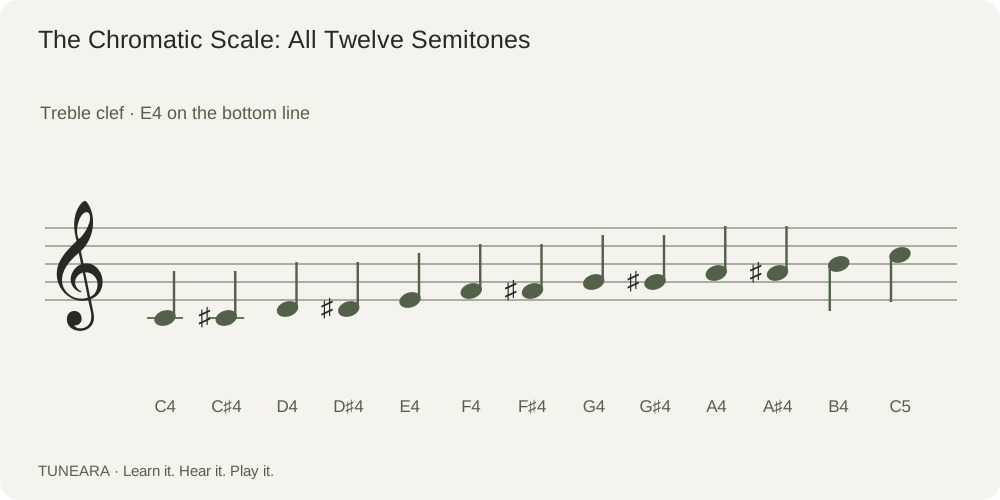
One ascending example is C–C-sharp–D–D-sharp–E–F–F-sharp–G–G-sharp–A–A-sharp–B–C. Descending spellings often use flats, but the context should guide notation. Count twelve semitone moves between the first C and the next C, rather than counting thirteen heads as thirteen distinct pitch classes.
Try it in practice
Play four neighboring semitones slowly, then continue to the octave. Keep the rhythm equal and name each pitch. On guitar, use one string first so the fret spacing directly shows the semitone steps. Check the octave arrival against the starting pitch rather than relying only on a finger pattern.
Avoid a common mistake
Do not add a sharp between E and F or B and C when describing the ordinary twelve-note keyboard cycle. Those natural pairs are already semitones apart. Also avoid confusing chromatic motion with a change of key: a passing chromatic note need not establish a new tonic.
Read the visual example
What to learn next
Connect this lesson to Whole Steps and Half Steps: Count Musical Distance, then try Scale Degrees: Name Notes by Their Role in a Key.
References and further learning

Get Tuneara
Your next practice
starts here.
A free tuner and metronome for iPhone and Android.