Diatonic Chords in a Major Key: Build the Seven Triads
Diatonic major-key triads use only the key’s scale notes. Their qualities follow major, minor, minor, major, major, minor, diminished.
How to build a triad on each major-scale degree
Build each triad by taking a scale degree, skipping one scale note, taking the next, and repeating. The scale’s uneven semitone pattern produces different chord qualities. Roman numerals show the roots relative to the key and usually use uppercase for major, lowercase for minor, and a diminished sign where needed.
Compare the seven chords in C major and G major
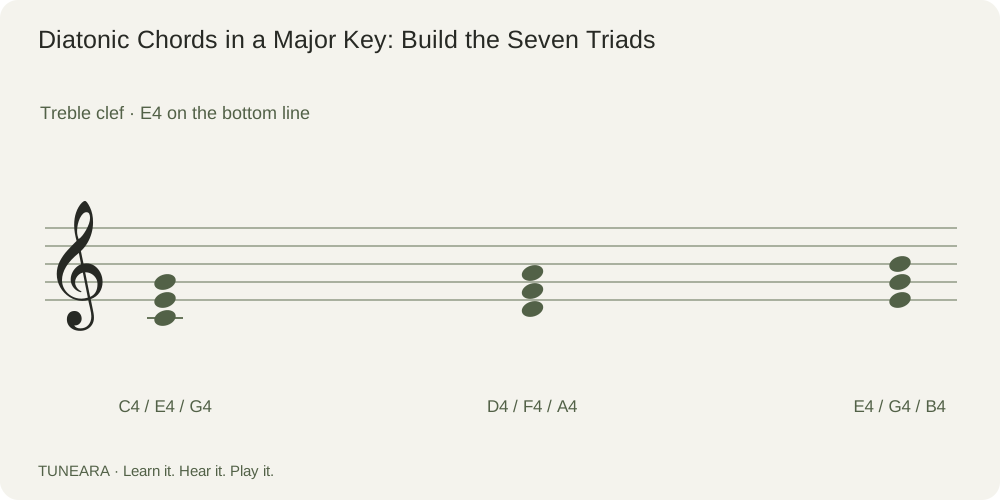
In C major, the triads are C, Dm, Em, F, G, Am, and B diminished. Dm is D–F–A, not D–F-sharp–A, because F-sharp is outside the C-major collection. Moving the process to G major includes F-sharp and gives G, Am, Bm, C, D, Em, and F-sharp diminished.
Try it in practice
Write the C-major scale and circle every other note from each starting degree, wrapping into the next octave. Check each triad’s third and fifth. Play I–IV–V–I, then add vi as a comparison. Describe the chord quality as well as its scale-degree root.
Avoid a common mistake
Do not build every chord as a major triad just because the key is major. Also do not assume non-diatonic chords are errors; chromatic harmony and borrowed chords are common. The diatonic list is a useful reference collection, not the only chords a piece may contain.
Read the visual example
What to learn next
Connect this lesson to Major Triads: Build Root, Third, and Fifth, then try Minor Triads: Lower the Third, Keep the Fifth.
References and further learning

Get Tuneara
Your next practice
starts here.
A free tuner and metronome for iPhone and Android.

