Diminished and Augmented Triads: Change the Fifth
A diminished triad has a minor third and diminished fifth above its root. An augmented triad has a major third and augmented fifth.
How diminished and augmented triads are built
Changing the fifth gives these triads a different structure from major and minor. In close root position, a diminished triad stacks two minor thirds, while an augmented triad stacks two major thirds. The chord’s spelling still uses a root, third, and fifth letter, even when accidentals are required.
Compare C diminished, C augmented, and B diminished
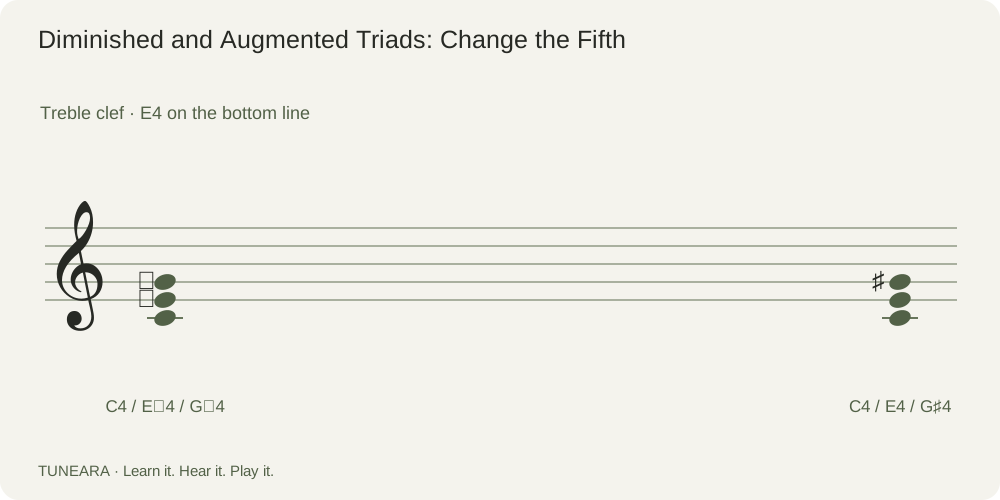
C diminished is C–E-flat–G-flat, with root distances of three and six semitones. C augmented is C–E–G-sharp, with distances of four and eight. B–D–F is the naturally occurring diminished triad on degree 7 of C major. These examples show why note names and semitone checks work together.
Try it in practice
Compare C minor with C diminished by changing only G to G-flat. Compare C major with C augmented by changing only G to G-sharp. Play the altered fifth separately against C, then hear the whole chord. Keep the same spacing so the comparison tests quality rather than register.
Avoid a common mistake
Do not confuse a diminished triad with a diminished seventh chord, which adds a fourth distinct member. An augmented chord’s altered fifth also does not mean every melody note above it must be raised. Interpret the symbol as a chord formula, then consider the surrounding progression.
Read the visual example
What to learn next
Connect this lesson to Major Triads: Build Root, Third, and Fifth, then try Minor Triads: Lower the Third, Keep the Fifth.
References and further learning

Get Tuneara
Your next practice
starts here.
A free tuner and metronome for iPhone and Android.

