Interval Ear Training: Compare Before You Name
← Back to Ear training exercises
For interval ear training, establish a reference, compare a small set of intervals, and sing or play the second note before checking its name.
Start interval ear training with two contrasting sounds
Learning two contrasting intervals is more manageable than testing every interval immediately. Keep the starting pitch, instrument sound, and direction consistent at first. Then vary one of them so you do not merely memorize an absolute pair of notes. Named intervals connect the sound to letter spelling and semitone distance.
Compare minor and major thirds from C and D
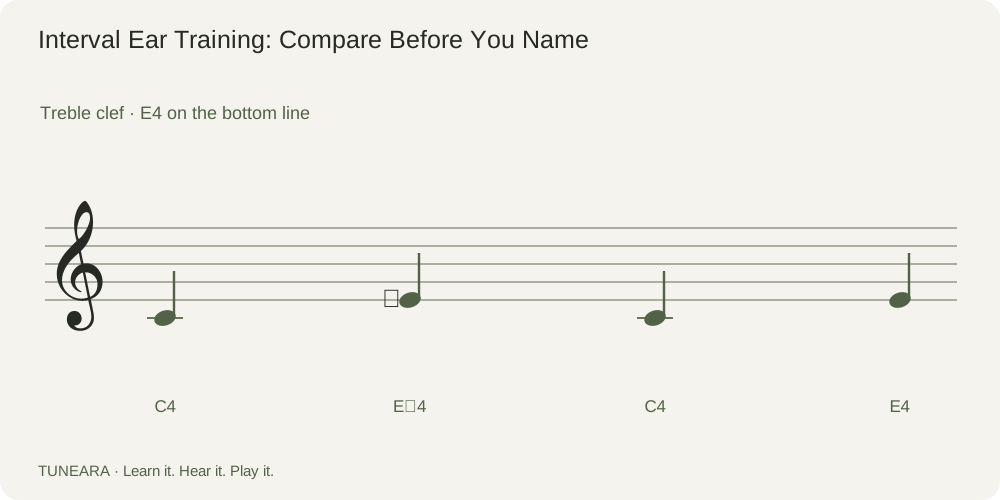
Compare C4–E-flat4 with C4–E4: minor and major thirds. The starting note remains fixed while the upper note changes by a semitone. After several trials, start from D4 and compare D4–F4 with D4–F-sharp4. The interval categories stay the same while the absolute pitches change.
Try it in practice
Play the starting note, sing the target interval, then check on an instrument. Alternate known examples and short identification attempts. Use both upward melodic pairs and simultaneous harmonic pairs in separate rounds. Track which presentation is harder so your next session has a focused goal.
Avoid a common mistake
Do not rely entirely on a song-opening association. It can be a useful memory cue, but may work only in one direction or tonal context. Also do not infer interval spelling from sound alone when enharmonic intervals share a frequency distance; written context supplies that distinction.
Read the visual example
What to learn next
Connect this lesson to Musical Intervals: Count Letters and Semitones, then try How to Match Pitch: Listen, Sing, and Check.
References and further learning

Get Tuneara
Your next practice
starts here.
A free tuner and metronome for iPhone and Android.