How to Match Pitch: Listen, Sing, and Check
← Back to Ear training exercises
To match a pitch, listen to one comfortable reference note, imagine it, then sing or play it and compare. Use small adjustments instead of chasing every tuner movement.
How to listen and adjust when matching a pitch
Pitch matching is a listening-and-response task. Start within a range that feels easy; a reference outside your comfortable voice range can lead to an octave substitution. A tuner can provide feedback, but the exercise should begin with listening so the screen does not become your only cue.
Compare your sung or played note with a reference
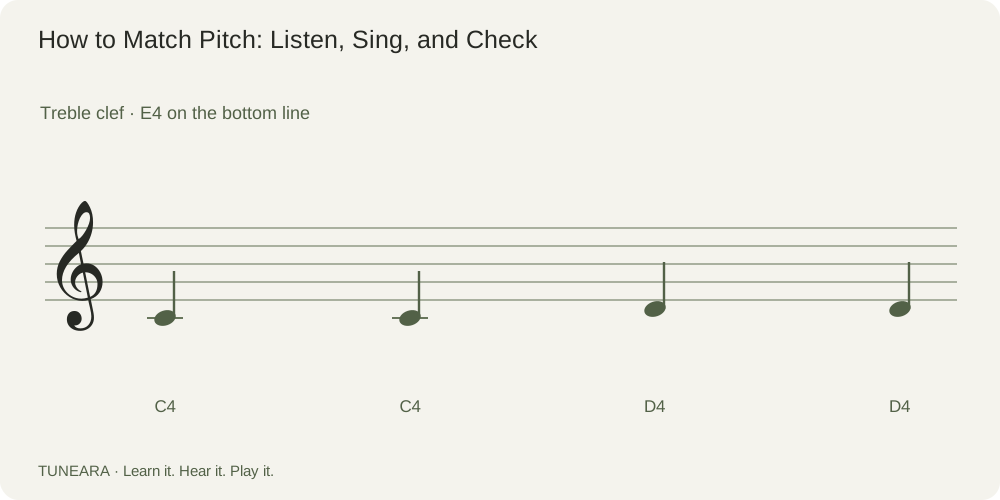
Play a steady C4 or another suitable note. Listen, stop the reference briefly, and reproduce it. Then sound the reference again to compare. If you sing an octave away, the letter may still match even though the pitch differs. Name the register when that distinction matters.
Try it in practice
Try three short attempts on the same note, resting between them. On each attempt, decide whether your response is higher, lower, or close before looking at a tuner. Then vary the reference within a small range. Keep volume gentle and stop if your voice feels strained; this is an accuracy exercise, not a range challenge.
Avoid a common mistake
Do not slide around continuously without first choosing a direction. Make a brief attempt, compare, and retry. Vibrato, background sound, and strong harmonics can move a display, so judge a settled tone. Consistent difficulty is a useful reason to work with a teacher, not a basis for diagnosing your hearing.
Read the visual example
What to learn next
Connect this lesson to Musical Intervals: Count Letters and Semitones, then try Sing Scale Degrees: Hear Notes Relative to a Tonic.
References and further learning

Get Tuneara
Your next practice
starts here.
A free tuner and metronome for iPhone and Android.