Hear Higher and Lower Notes Without Confusing Loudness
← Back to Ear training exercises
To compare pitch direction, listen for whether the second tone is higher or lower in register. Loudness and tone color can change without changing the pitch.
How to hear pitch direction without loudness clues
Begin with widely separated notes in the same instrument sound and at similar volume. This removes extra clues and distractions. Once the direction is clear, make the distance smaller. You are learning contour first, not identifying a named interval or an exact frequency from memory.
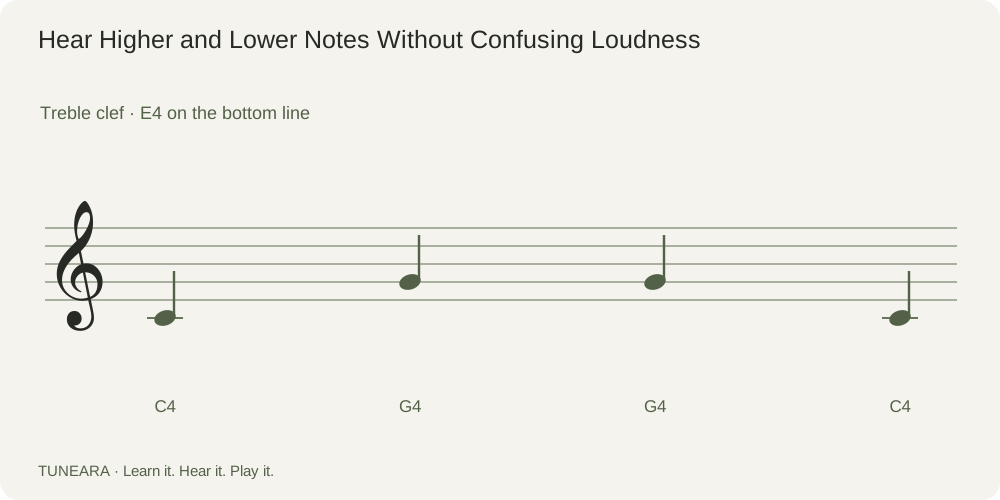
Compare rising C–G with falling G–C
C4 followed by G4 rises, while G4 followed by C4 falls. A louder C4 is still C4; a bright timbre can seem more intense without moving the fundamental. Octave-equivalent notes share a letter but still have an upward or downward relationship in register.
Try it in practice
Ask a partner to play two notes within a comfortable octave, or make a few labeled reference examples and listen later. Answer “up,” “down,” or “same,” then verify. Begin with fourths and fifths and move toward seconds only when your comparisons are consistent. Record which conditions are difficult rather than only counting correct answers.
Avoid a common mistake
Do not let a change in volume answer the pitch question. Use the same sound source while learning. Avoid treating an isolated difficult comparison as proof of a permanent inability; unfamiliar register, timbre, and spacing can change the task. Reduce one complication at a time.
Read the visual example
What to learn next
Connect this lesson to Musical Intervals: Count Letters and Semitones, then try How to Match Pitch: Listen, Sing, and Check.
References and further learning

Get Tuneara
Your next practice
starts here.
A free tuner and metronome for iPhone and Android.