Sing Scale Degrees: Hear Notes Relative to a Tonic
← Back to Ear training exercises
Singing scale degrees connects pitches to a tonal center. Establish a comfortable tonic, sing a short degree pattern, then check it on an instrument.
How scale degrees and movable do relate to a tonic
Degree numbers or movable-do syllables describe relationships rather than fixed absolute pitches. In a major key, 1 is do, 2 re, 3 mi, 4 fa, 5 sol, 6 la, and 7 ti in one common system. Minor solfège conventions vary, so choose a consistent approach with your teacher or materials.
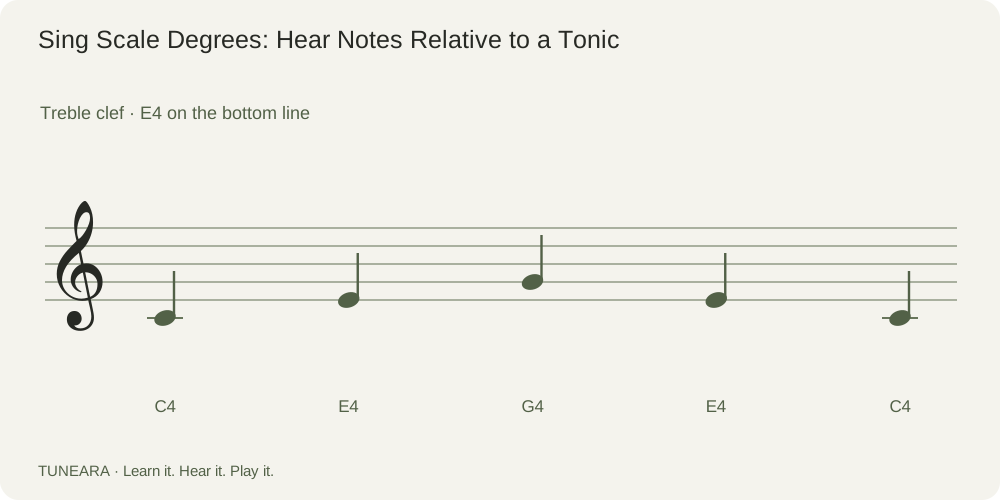
Transpose 1–3–5–3–1 from C major to G major
In C major, 1–3–5–3–1 is C–E–G–E–C. Move the tonic to G and the same degree pattern becomes G–B–D–B–G. A comfortable voice register is more useful than forcing either example into a specific octave shown on a page.
Try it in practice
Play a tonic chord, then sing 1–2–3–2–1 gently. Check the pitches afterward. Try 1–3–5–3–1 next and keep the tonic in memory between attempts. Transpose to a nearby comfortable key, naming the new notes before you sing. Pause if the reference fades instead of continuing with an uncertain center.
Avoid a common mistake
Do not strain to match an uncomfortable register. Shift the whole exercise by an octave or choose another key. A scale-degree pattern also needs a stated collection: degree 3 in major and natural minor differs. Keep the key and scale form explicit when checking your answer.
Read the visual example
What to learn next
Connect this lesson to Musical Intervals: Count Letters and Semitones, then try How to Match Pitch: Listen, Sing, and Check.
References and further learning

Get Tuneara
Your next practice
starts here.
A free tuner and metronome for iPhone and Android.