Build a Music Practice Routine with One Clear Goal
← Back to Music practice routines
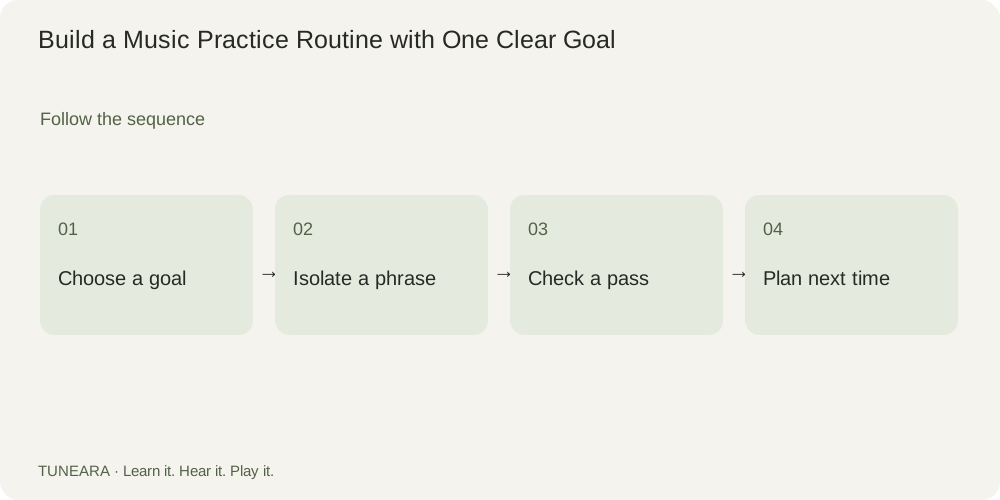
A useful practice routine sets one observable goal, works on a small task, checks the result, and revisits it later. Adjust the time and difficulty to your own needs.
How to choose a specific music practice goal
Begin by naming the problem precisely: a rushed transition, an uncertain interval, or a chord change with extra tension. “Get better” gives you little feedback. A small goal lets you choose a method and hear whether it helps. Breaks and a manageable load matter more than completing a fixed schedule at all costs.
Try a flexible 15-minute practice routine
A suggested 15-minute session might spend two minutes setting up and tuning, five on one difficult transition, four connecting it to a phrase, two recording a pass, and two noting the result and next step. Adjust the time blocks to your available time and the difficulty of the passage.
Try it in practice
Choose two measures and write a goal such as “keep the eighths even through the change.” Play slowly, identify one mismatch, and adjust only that detail. Record a later attempt and compare it with the goal. Finish by playing the surrounding phrase so the isolated work reconnects with the music.
Avoid a common mistake
Do not equate repetition count or metronome speed with learning quality. Repeating an unclear task can preserve the same mistake. If discomfort appears, stop and reassess technique with appropriate guidance. Keep notes brief enough that recording practice does not consume the whole session.
Read the visual example
What to learn next
Connect this lesson to a metronome practice routine, then try How to Read Sheet Music: A First-Pass Routine.
References and further learning

Get Tuneara
Your next practice
starts here.
A free tuner and metronome for iPhone and Android.