Harmonic Minor: Raise the Seventh Degree
← Back to Music scales and keys
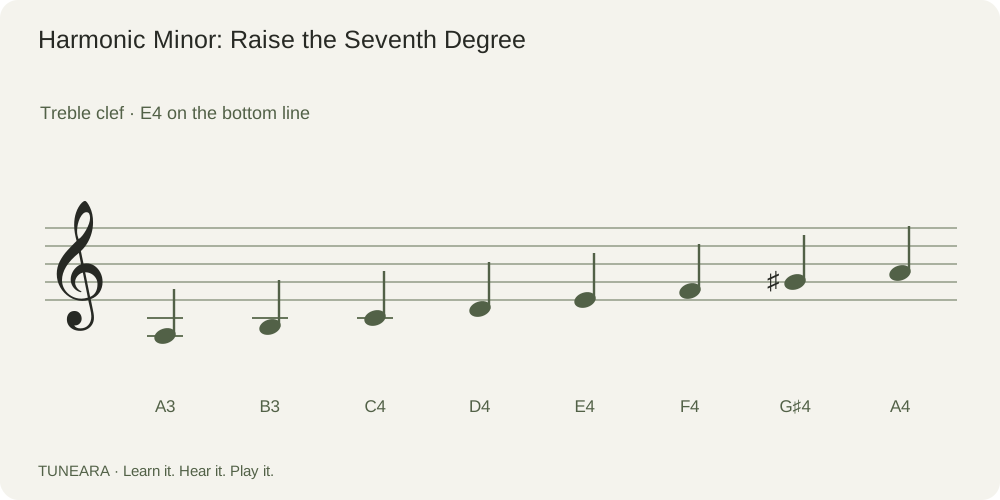
Harmonic minor raises the seventh degree of natural minor. A harmonic minor is A, B, C, D, E, F, G-sharp, A.
Why harmonic minor raises the seventh degree
The raised seventh creates a leading tone one semitone below the tonic. It also allows a major dominant triad in the minor key: E–G-sharp–B in A minor. The scale is a useful representation of that harmonic resource, rather than a rule that every minor-key melody must follow one fixed collection.
Compare G–A with G-sharp–A in A minor
Compare A natural minor’s G–A whole step with harmonic minor’s G-sharp–A half step. Between F and G-sharp lies an augmented second, three semitones with neighboring letters. Calling it a minor third would ignore the spelling even though an equal-tempered minor third has the same semitone span.
Try it in practice
Play E–G-sharp–B, then A–C–E, and listen to the dominant-to-tonic motion. Sing G-sharp up to A separately. Next, compare the full natural and harmonic minor scales at a slow pace, keeping the tonic fixed so the changed seventh stands out.
Avoid a common mistake
Do not put G-sharp into A minor’s key signature. The normal signature remains the one shared with C major, and the raised seventh is written as an accidental where needed. Minor-key pieces can mix forms according to melodic and harmonic context rather than staying inside one diagram.
Read the visual example
What to learn next
Connect this lesson to Whole Steps and Half Steps: Count Musical Distance, then try Scale Degrees: Name Notes by Their Role in a Key.
References and further learning

Get Tuneara
Your next practice
starts here.
A free tuner and metronome for iPhone and Android.