Major Pentatonic Scale: Five Notes You Can Use
← Back to Music scales and keys
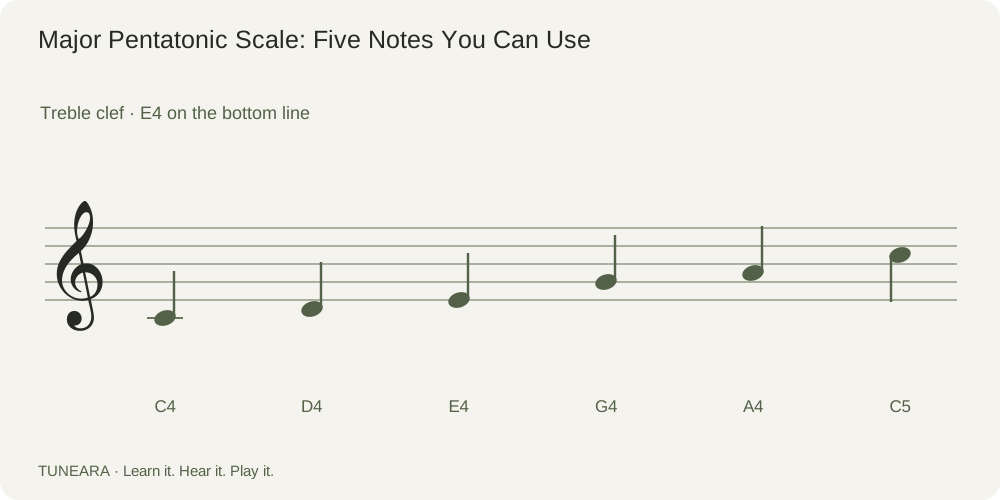
Major pentatonic uses degrees 1, 2, 3, 5, and 6 of a major scale. C major pentatonic is C, D, E, G, and A.
Which degrees form a major pentatonic scale?
Pentatonic means five-note. This collection omits major-scale degrees 4 and 7, removing the two half-step pairs found within a major scale. Its compact set can be useful for melody practice, but choosing five notes does not automatically make every phrase fit every chord. Listen to the current harmony.
Build a five-note phrase from C major pentatonic
From C major, keep C–D–E, skip F, keep G–A, and skip B. At the octave return to C. G major pentatonic is G–A–B–D–E. The scale can appear across several positions on an instrument; the pitch collection remains the same despite a different fingering.
Try it in practice
Use only C–D–E–G–A over a sustained C reference or a simple C-major chord. Make a two-measure phrase with one repeated rhythmic idea, then answer it with a different ending. Finish on C first, then on E or G, and compare how each ending relates to the tonic chord.
Avoid a common mistake
Do not confuse C major pentatonic with C minor pentatonic. Their roots match but their other notes differ. A major pentatonic also shares its notes with a relative minor pentatonic: C major and A minor are related that way. The phrase’s center still matters.
Read the visual example
What to learn next
Connect this lesson to Whole Steps and Half Steps: Count Musical Distance, then try Scale Degrees: Name Notes by Their Role in a Key.
References and further learning

Get Tuneara
Your next practice
starts here.
A free tuner and metronome for iPhone and Android.