Mandolin Tuning: GDAE and Paired Strings
← Back to Instrument tuning guides
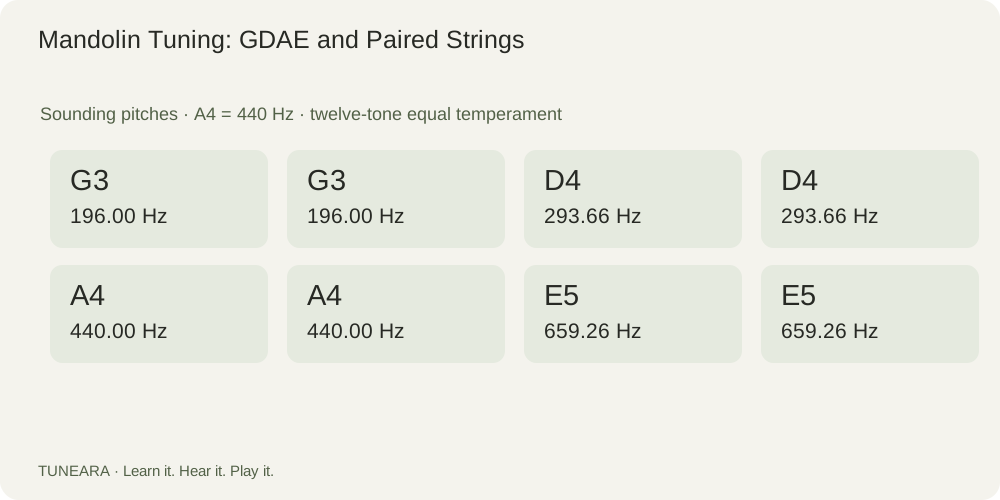
Standard mandolin tuning is G3–D4–A4–E5 across four courses, low to high. Each course normally contains two strings tuned to the same pitch.
How mandolin courses pair strings at the same pitch
The paired strings create eight strings but four main pitch targets. Tune one member of a pair while damping the other, then match its partner. Listen to the pair together afterward. A small difference within a course can create beating even when each separate tuner reading looks close.
Check GDAE targets across the four courses
The courses match violin’s open-string pitch sequence: G3, D4, A4, E5. At A4 = 440 Hz, their targets are about 196.00, 293.66, 440.00, and 659.26 Hz. This shared sequence does not mean the instruments use the same strings, setup, or tuning mechanism.
Try it in practice
Work from the G course upward, checking individual strings and then each pair. Repeat the full set after the first pass. Play a simple open-string pattern to hear whether one course wavers more than the others. Keep pick attack moderate so the initial transient does not dominate your judgment.
Avoid a common mistake
Do not mistake a course for one physical string, and do not tune the two members an octave apart unless a specific instrument and string set are designed for that layout. Standard mandolin pairs here are unisons. Check a maker’s instructions before making a large change or installing an unfamiliar set.
Read the visual example
What to learn next
Connect this lesson to pitch, frequency, and cents, then try standard instrument targets.
References and further learning

Get Tuneara
Your next practice
starts here.
A free tuner and metronome for iPhone and Android.

