Melodic Minor: Classical and Jazz Conventions
← Back to Music scales and keys
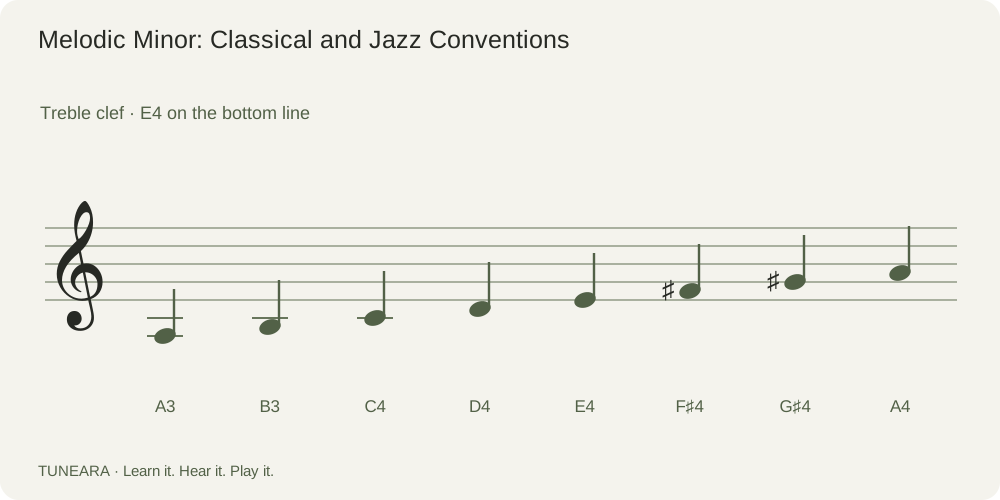
Classical melodic minor commonly raises degrees 6 and 7 ascending and uses natural minor descending. Jazz melodic minor commonly keeps the raised form in both directions.
Classical melodic minor and jazz melodic minor
In A, the raised collection is A–B–C–D–E–F-sharp–G-sharp–A. Raising the sixth removes the augmented-second gap found in harmonic minor between F and G-sharp, while the raised seventh retains a leading tone. These are conventions for describing common materials, not a claim that every melody obeys a mechanical direction rule.
Compare the ascending and descending minor forms
A classical scale exercise often descends A–G–F–E–D–C–B–A. A jazz melodic-minor exercise may descend A–G-sharp–F-sharp–E–D–C–B–A. The difference belongs to the stated convention. Real classical phrases can keep raised notes descending when the harmony or melodic line calls for them.
Try it in practice
Play A natural minor, then the raised melodic-minor collection. Isolate E–F-sharp–G-sharp–A and compare with E–F–G–A. Try both descending conventions while saying which one you are using. Keep an A reference nearby so your ear tracks the altered upper degrees against the same tonic.
Avoid a common mistake
Do not mix the two conventions without labeling them in a lesson or exercise. The name alone may be ambiguous across styles. Also avoid treating the ascending form as A major: the third remains C natural, preserving the minor tonic quality.
Read the visual example
What to learn next
Connect this lesson to Whole Steps and Half Steps: Count Musical Distance, then try Scale Degrees: Name Notes by Their Role in a Key.
References and further learning

Get Tuneara
Your next practice
starts here.
A free tuner and metronome for iPhone and Android.

