Melodic vs. Harmonic Intervals: One After Another or Together
← Back to Music scales and keys
A melodic interval presents two pitches in sequence; a harmonic interval presents them together. The interval’s pitch distance can be the same in both cases.
What makes an interval melodic or harmonic?
“Melodic” and “harmonic” describe presentation, not a different set of interval names. You can hear a major third as C followed by E, or as C and E sounding simultaneously. The first makes contour explicit; the second lets you hear the combined sonority and any beating or roughness in the sound.
Hear the same two pitches separately and together
Play C4 then G4 to hear an ascending melodic perfect fifth. Reverse them to hear a descending fifth. Sound them together for a harmonic fifth. The two absolute pitches remain the same, but the listening task changes. A recognizable tune can help recall an interval, though it should not be your only strategy.
Try it in practice
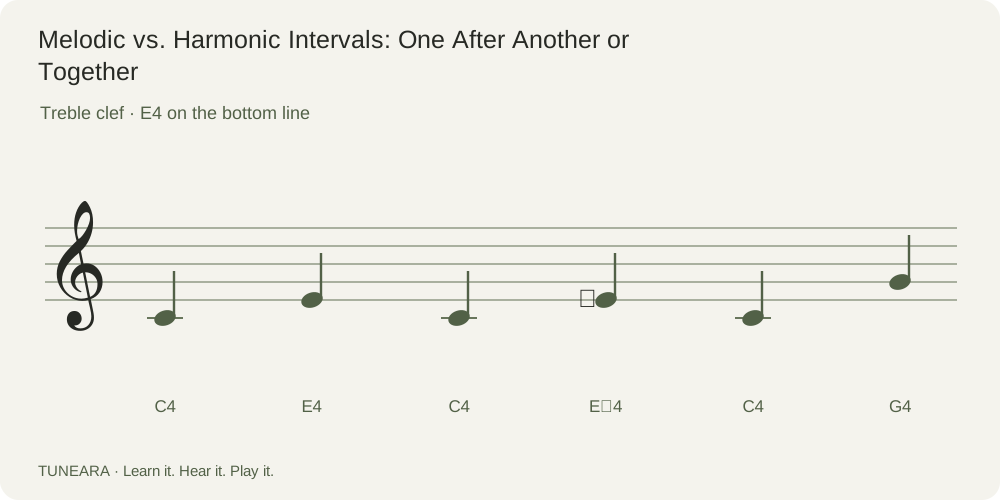
Choose C–E and C–E-flat. Play each sequentially, sing the second note from the first, then play the pair together. Keep both pitches in the same register across attempts. After a few comparisons, hide your hands from view or ask a partner to vary the order so visual clues do not answer for you.
Avoid a common mistake
Do not equate “harmonic interval” with the harmonic minor scale; those are different terms. A chord can contain several harmonic intervals at once. If identifying them is difficult, reduce the chord to two notes before adding a third or moving to inversions.
Read the visual example
What to learn next
Connect this lesson to Whole Steps and Half Steps: Count Musical Distance, then try Scale Degrees: Name Notes by Their Role in a Key.
References and further learning

Get Tuneara
Your next practice
starts here.
A free tuner and metronome for iPhone and Android.

