Minor Pentatonic Scale: Degrees, Notes, and First Phrases
← Back to Music scales and keys
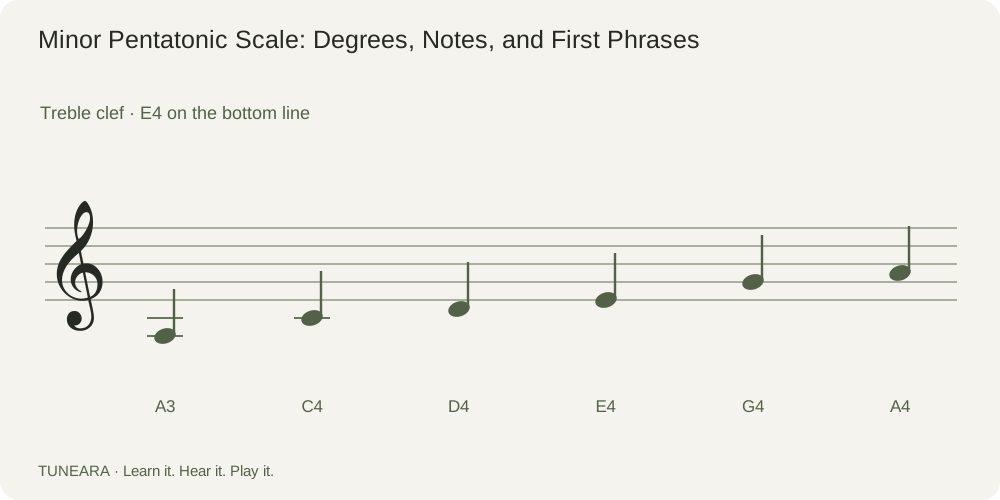
Minor pentatonic uses degrees 1, flat 3, 4, 5, and flat 7 relative to major. A minor pentatonic is A, C, D, E, and G.
Which degrees form a minor pentatonic scale?
The five pitches form a collection rather than a fixed sequence you must always play upward. Degree labels make it portable: from C, the notes become C–E-flat–F–G–B-flat. Learn the roots inside a fingering pattern so you can place phrases intentionally instead of running a shape without hearing its center.
Find the five notes of A minor pentatonic
A–C–D–E–G contains the same notes as C major pentatonic, but A can be emphasized as home. Over an A-minor harmony, A, C, and E belong to the tonic triad. D and G can give melodic motion around that chord; their effect depends on duration and the surrounding harmony.
Try it in practice
Play a short A–C–D–C–A phrase, then answer E–G–E–D–A. Use a steady simple rhythm and leave a rest between the phrases. Sing the ending A before playing it. Change the rhythm on a second pass while keeping the same notes to hear how phrasing changes the musical result.
Avoid a common mistake
Do not treat the scale as a guarantee that every sustained note works over every progression. Blues styles may deliberately mix major and minor elements, while other contexts require more specific chord-tone choices. Label the tonic and harmony of your exercise rather than describing the shape alone.
Read the visual example
What to learn next
Connect this lesson to Whole Steps and Half Steps: Count Musical Distance, then try Scale Degrees: Name Notes by Their Role in a Key.
References and further learning

Get Tuneara
Your next practice
starts here.
A free tuner and metronome for iPhone and Android.