The Natural Minor Scale: Notes and Step Pattern
← Back to Music scales and keys
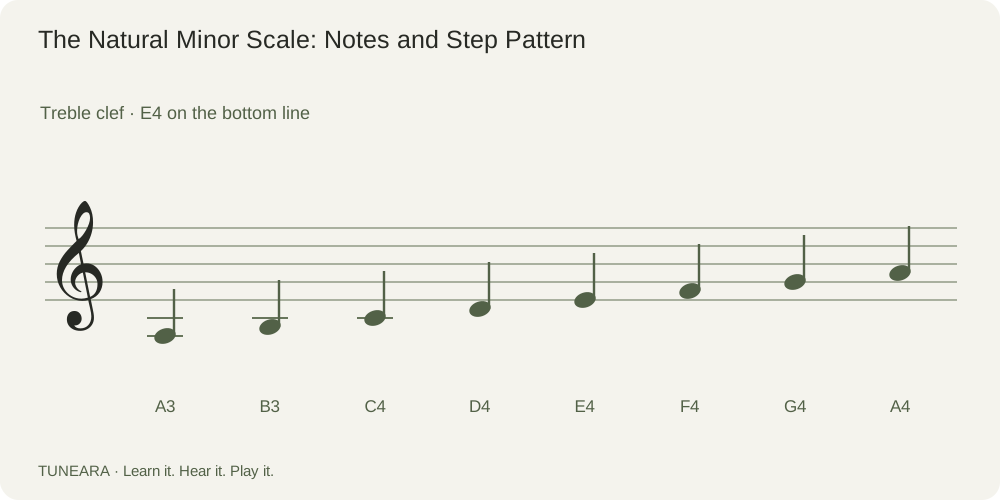
Natural minor follows whole, half, whole, whole, half, whole, whole steps. Relative to a parallel major scale, its third, sixth, and seventh degrees are lowered.
How to build the natural minor scale
The tonic is the pitch treated as home. Natural minor’s interval pattern begins there, so merely listing a major collection from a different note is not enough to establish a minor musical center. Phrase endings, bass notes, and harmony reinforce that center. Start with the pattern and listen for the tonic.
Compare natural minor with its major-scale reference
A natural minor is A–B–C–D–E–F–G–A. Compared with A major, C-sharp, F-sharp, and G-sharp are lowered. It shares its unaltered notes with C major, but A is the center in this example. E natural minor uses E–F-sharp–G–A–B–C–D–E.
Try it in practice
Play A–B–C, then return to A and sustain it. Continue through the full A-minor collection and end on A again. Compare A–C–E with A–C-sharp–E to isolate the third that distinguishes a minor tonic triad from a major one. Keep the same register and volume for the comparison.
Avoid a common mistake
Do not assume all minor-key music uses only natural minor. Raised sixths and sevenths appear in harmonic and melodic contexts. Treat natural minor as an important collection, not a prohibition against other notes. The relative major shares its key signature but does not replace the minor tonic.
Read the visual example
What to learn next
Connect this lesson to Whole Steps and Half Steps: Count Musical Distance, then try Scale Degrees: Name Notes by Their Role in a Key.
References and further learning

Get Tuneara
Your next practice
starts here.
A free tuner and metronome for iPhone and Android.