The I–IV–V Progression: Learn Three Core Major-Key Chords
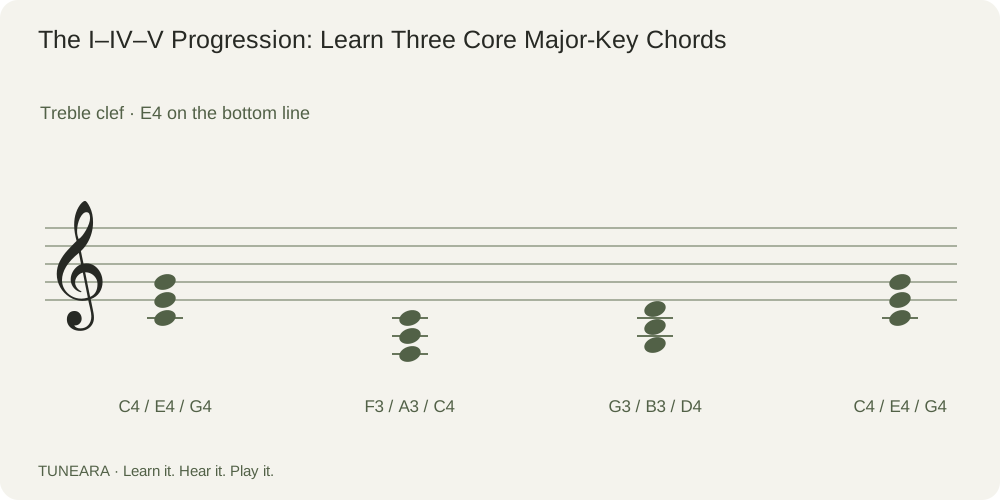
In a major key, I, IV, and V are major chords built on degrees 1, 4, and 5. In C, they are C, F, and G.
Why I, IV, and V are major chords in a major key
The tonic I provides a reference point, IV moves to the subdominant area, and V often points back toward tonic in tonal practice. These are common functions, not promises about every style or phrase. You can learn the relationships with simple triads before adding sevenths or elaborate voicings.
Play the C–F–G progression and locate its roots
In C major, spell C–E–G, F–A–C, and G–B–D. G7 adds F and can make the return to C more explicit through B–C and F–E motion. In G major, the same progression uses G, C, and D, showing why numeral relationships travel between keys.
Try it in practice
Play one measure each of C, F, G, and C in 4/4. Count every beat, then try one chord every two beats without changing tempo. Next, choose nearby inversions so the upper voices move less. Sing the bass roots separately before combining them with chords.
Avoid a common mistake
Do not confuse I–IV–V with the written sequence 1–4–5 as individual melody notes. Each numeral represents a chord. Also keep the harmonic rhythm deliberate: switching chords early because a fingering is difficult changes the phrase. Slow the pulse until every change arrives where intended.
Read the visual example
What to learn next
Connect this lesson to Major Triads: Build Root, Third, and Fifth, then try Minor Triads: Lower the Third, Keep the Fifth.
References and further learning

Get Tuneara
Your next practice
starts here.
A free tuner and metronome for iPhone and Android.