Parallel Major and Minor: Keep the Tonic, Change the Scale
← Back to Music scales and keys
Parallel major and minor share a tonic, such as C major and C minor. Natural minor lowers the major scale’s third, sixth, and seventh degrees.
How parallel keys keep the same tonic
Because the tonic stays fixed, parallel comparisons make changed scale degrees easy to hear. The key signatures differ even though the starting letter stays the same. This relationship supports contrasts within a composition and helps explain borrowed chords, but it does not make major and minor interchangeable labels.
Compare the notes of C major and C natural minor
C major is C–D–E–F–G–A–B–C. C natural minor is C–D–E-flat–F–G–A-flat–B-flat–C. The tonic and degrees 2, 4, and 5 remain the same. C minor’s signature has three flats, while its relative major is E-flat, not C.
Try it in practice
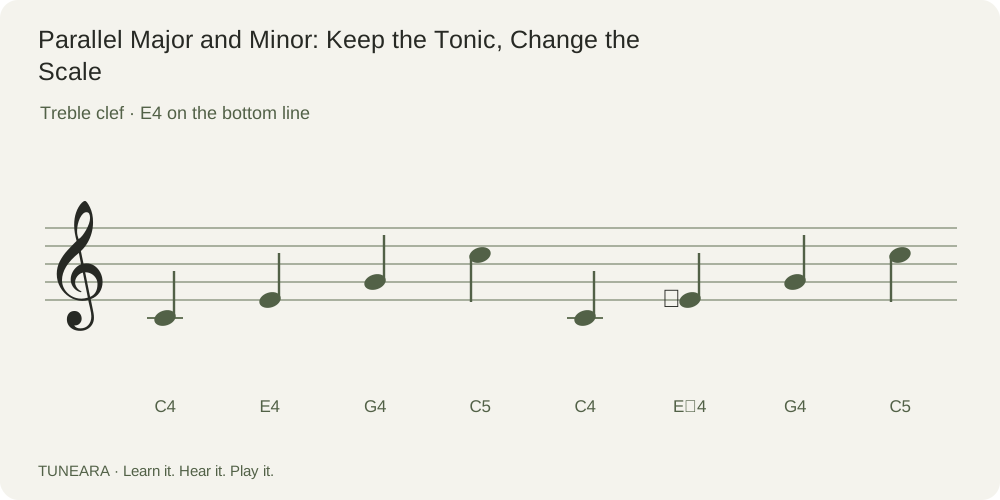
Alternate C–E–G and C–E-flat–G as slow broken chords. Hold the same C bass underneath both. Then compare the full scales, naming the three altered degrees as they arrive. Keeping the root and register fixed makes the harmonic change easier to isolate than comparing unrelated keys.
Avoid a common mistake
Do not confuse parallel with relative minor. A minor is relative to C major, while C minor is parallel. Also state which minor form you mean: harmonic minor raises the seventh and ascending classical melodic minor raises sixth and seventh, so “lower three degrees” specifically describes natural minor.
Read the visual example
What to learn next
Connect this lesson to Whole Steps and Half Steps: Count Musical Distance, then try Scale Degrees: Name Notes by Their Role in a Key.
References and further learning

Get Tuneara
Your next practice
starts here.
A free tuner and metronome for iPhone and Android.