Relative Major and Minor: Same Signature, Different Home
← Back to Music scales and keys
Relative major and natural minor share a key signature and pitch collection. The minor tonic lies a minor third below the relative major tonic.
Why relative keys share a signature
C major and A minor both have no sharps or flats in their key signatures. Their shared notation does not make them the same key. A musical key includes a tonic hierarchy: which pitch and chord feel like a point of rest. Determine that from the phrase and harmony as well as the signature.
Compare C major and A minor as different tonal homes
The sixth degree of C major is A, giving its relative minor. In G major, degree 6 is E, so E minor shares G major’s one-sharp signature. Moving from E minor to its relative major means going up a minor third to G, not simply selecting any scale with a G in it.
Try it in practice
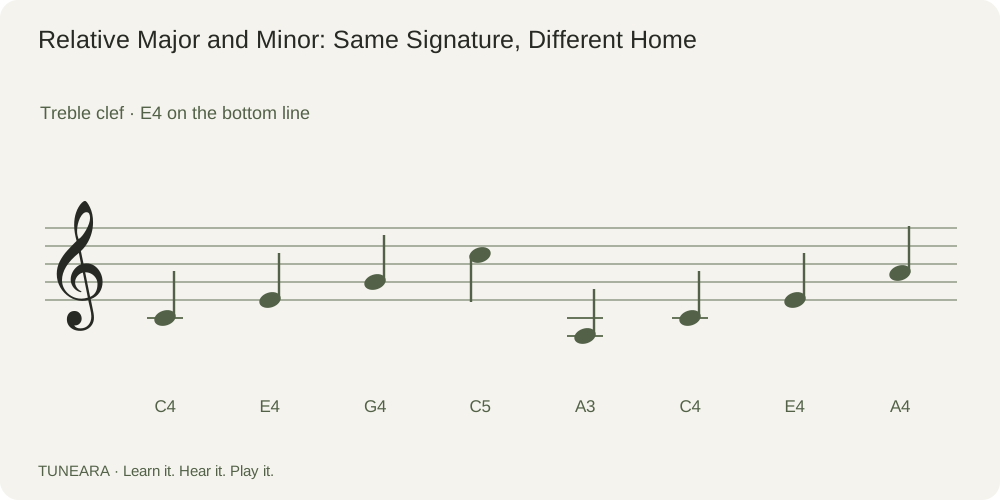
Play C–E–G–C, then A–C–E–A. Use only the shared natural-note collection and sustain the final tonic each time. Write the two key names beside the same blank signature. Next, find the relative minor of D major by naming its sixth degree: B.
Avoid a common mistake
Do not identify a key only from the first note of a melody. A piece can begin away from its tonic, and minor-key music often raises notes beyond the natural-minor signature. “Relative” means a shared signature relationship; “parallel” means a shared tonic and a different collection.
Read the visual example
What to learn next
Connect this lesson to Whole Steps and Half Steps: Count Musical Distance, then try Scale Degrees: Name Notes by Their Role in a Key.
References and further learning

Get Tuneara
Your next practice
starts here.
A free tuner and metronome for iPhone and Android.

