Rests in Music: Read and Count Silence
A rest specifies a duration without a new sounding note in that part. Count through it with the same pulse you use for the surrounding notes.
What rest symbols tell you about duration
Rests have values corresponding to notes: quarter, eighth, half, and so on. The symbol changes, but the time relationship does not. A quarter rest occupies the same written duration as a quarter note. Silence belongs to the rhythmic pattern and should not be treated as a pause of arbitrary length.
| Rest value | Duration |
|---|---|
| Whole rest (duration value) | 4 beats |
| Half rest | 2 beats |
| Quarter rest | 1 beat |
| Eighth rest | ½ beat |
| Sixteenth rest | ¼ beat |
These beat counts assume a quarter-note beat. A whole-measure rest represents the full measure, whose length depends on the time signature. Once you recognize the values, use counting through rests to practice offbeat entries and silent measures.
Read rest values within a measure
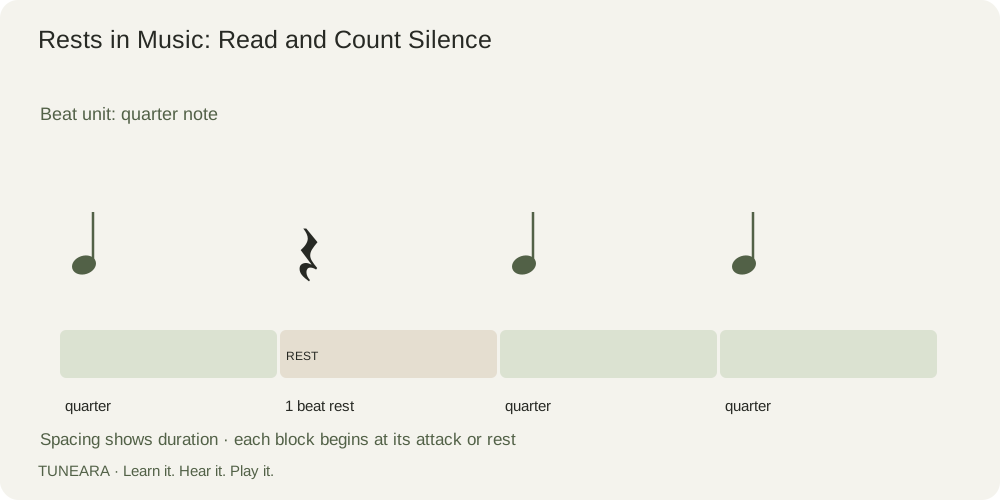
In a 4/4 measure, play a quarter note on beat 1, rest on beat 2, then play quarters on 3 and 4. Count all four beats aloud. A whole-measure rest normally means an entire measure of silence, including meters where that measure is not exactly the length of a whole note.
Try it in practice
Clap the pattern on beats 1, 3, and 4 while tapping your foot on all four beats. Then move the rest to beat 3 without changing tempo. Repeat once while counting silently and check whether the next measure begins in the same place. Keep releases clear rather than allowing every note to ring through its rest.
Avoid a common mistake
Do not stop counting because your hands stop playing. In an ensemble, another part may continue during your rest. Also distinguish a rest from a tie: a tied note continues sounding, while a rest indicates no sounding note in that voice for its duration. Instrument resonance can require active damping.
Read the visual example
What to learn next
Connect this lesson to Treble Clef Notes: Lines, Spaces, and Landmarks, then try Note Values: Whole, Half, Quarter, and Eighth Notes.
References and further learning

Get Tuneara
Your next practice
starts here.
A free tuner and metronome for iPhone and Android.