How to Count Through Rests Without Losing Your Place
Keep counting the pulse and subdivisions through rests, then place the next attack at its written position. Silence changes what you play, not how time continues.
Keep the count moving during a rest
If the symbols are unfamiliar, first learn music rest symbols and values. This exercise focuses on keeping time and placing your next entry.
A rest can hide the physical action that normally reminds you of the beat. Preserve a small internal or external pulse while your instrument is silent. The amount of subdivision you need depends on the passage: quarter counting may be enough for a long rest, while an offbeat entry benefits from eighths or sixteenths.
Locate the next attack after silence
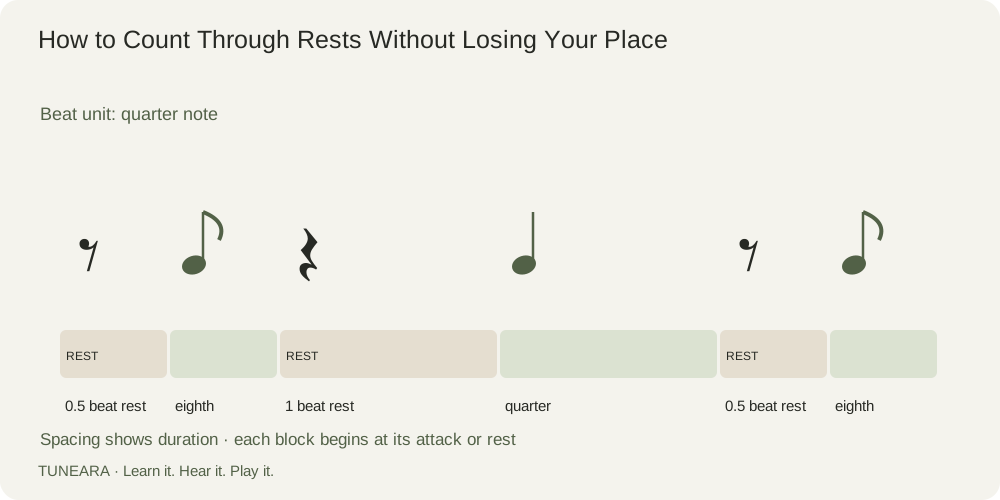
In 4/4, an eighth rest on beat 1 followed by an eighth note on “and” puts the first attack between beats. If you wait until the next full beat, you shift the whole pattern. Four quarter rests fill a measure, but a whole-measure rest symbol can represent the complete measure more compactly.
Try it in practice
Count “1 and 2 and 3 and 4 and.” Clap only “and of 1,” beat 3, and “and of 4.” Repeat without changing your spoken subdivision. Then let one full measure remain silent before reentering. Check that the return lands on the next 1 rather than on the first moment you feel ready.
Avoid a common mistake
Do not turn a rest into an unmeasured breath or reset unless the score asks for one. Also release preceding notes accurately: a note held through a written rest changes the sounding pattern. Wind players should plan breathing within the written timing rather than adding a beat to fit it.
Read the visual example
What to learn next
Connect this lesson to BPM and beat length, then try time signatures and beat grouping.
References and further learning

Get Tuneara
Your next practice
starts here.
A free tuner and metronome for iPhone and Android.

