Rhythmic Dictation: Write Attacks and Durations by Ear
← Back to Ear training exercises
For rhythmic dictation, find the pulse and meter, mark where attacks occur, then choose note and rest values that fill each measure correctly.
How to separate rhythm from pitch in dictation
One pass can locate the main beats, another the subdivisions, and another sustained sounds or silence. Use a simple grid before engraving if that helps. Attacks show beginnings; durations and rests show what happens until the next event. A correct attack pattern with incorrect releases is only a partial transcription.
Map attacks to beats before choosing note values
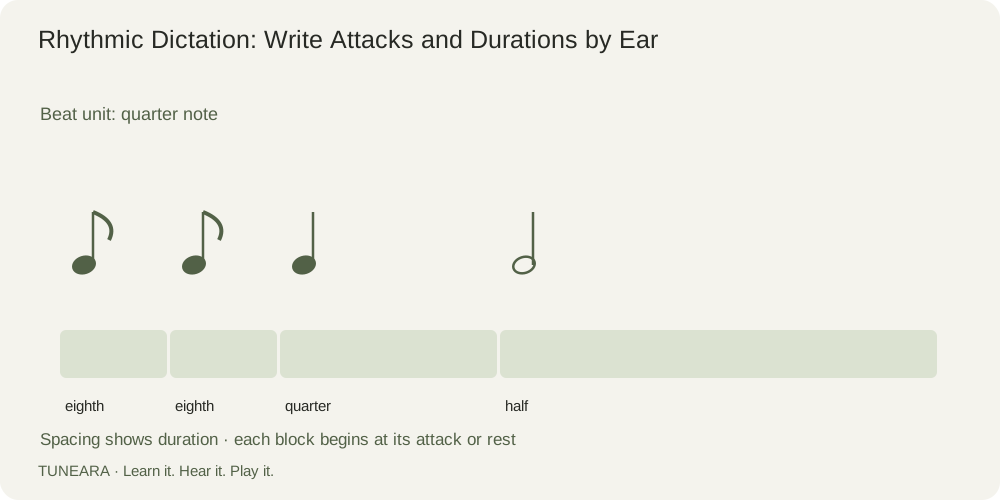
In 4/4, two eighths followed by a quarter and a half fill four quarter-note beats. Their attacks occur on 1, “and of 1,” 2, and 3, with the final note held through 4. A grid with only onset dots needs extra duration information to show that hold.
Try it in practice
Listen to a two-measure single-pitch example. Tap quarters, then write the count under a blank measure. Mark the attacks before choosing the note symbols. Clap your result while a partner repeats the original. Check that the duration total matches the meter and that rests remain timed.
Avoid a common mistake
Do not assign a new notehead to every subdivision you count internally. Counts can continue during a sustained note. Also distinguish tied durations from new attacks: the same pitch sounding continuously across a beat should not be transcribed as two separate strikes merely to simplify the arithmetic.
Read the visual example
What to learn next
Connect this lesson to Musical Intervals: Count Letters and Semitones, then try How to Match Pitch: Listen, Sing, and Check.
References and further learning

Get Tuneara
Your next practice
starts here.
A free tuner and metronome for iPhone and Android.