Roman Numeral Chords: Read Harmony Relative to a Key
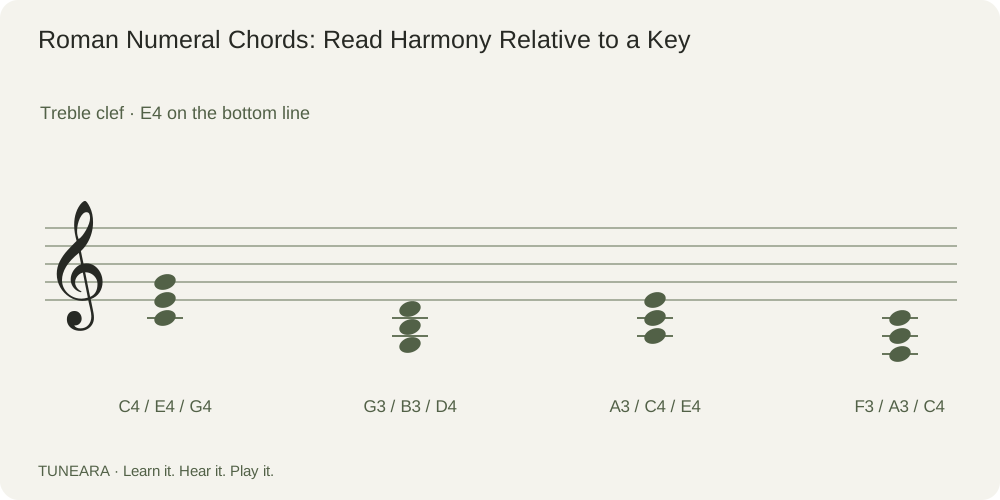
Roman numerals identify chord roots by scale degree. In C major, I is C, ii is D minor, IV is F, and V is G.
How Roman numerals describe chords within a key
The key provides the reference. Uppercase normally marks major triads and lowercase minor triads in the convention used here. A small diminished circle identifies a diminished triad. Extra figures, accidentals, or seventh signs add information. A Roman numeral describes harmony, while an Arabic scale-degree number can describe a single melodic note.
Read I, ii, IV, and V in a major-key progression
I–V–vi–IV in C gives C–G–Am–F. In G it gives G–D–Em–C. The progression keeps its relationships even though every absolute chord name changes. In minor-key analysis, conventions differ over how altered degrees are indicated, so state the system rather than silently mixing major-reference and minor-reference labels.
Try it in practice
Choose C major, write I–IV–V–I, and spell each triad. Move to D major and rebuild D–G–A–D using that key’s notes. Play both at the same slow harmonic rhythm. Name the tonic before each progression so the analysis has a clear anchor.
Avoid a common mistake
Do not read V as the letter V or as a fixed G chord in every key. It means a root on degree 5 with the quality specified by the notation. Roman numerals also do not prescribe one fingering, inversion, or rhythm; those details need the score or arrangement.
Read the visual example
What to learn next
Connect this lesson to Major Triads: Build Root, Third, and Fifth, then try Minor Triads: Lower the Third, Keep the Fifth.
References and further learning

Get Tuneara
Your next practice
starts here.
A free tuner and metronome for iPhone and Android.