The ii–V–I Progression: A First Jazz Harmony Exercise
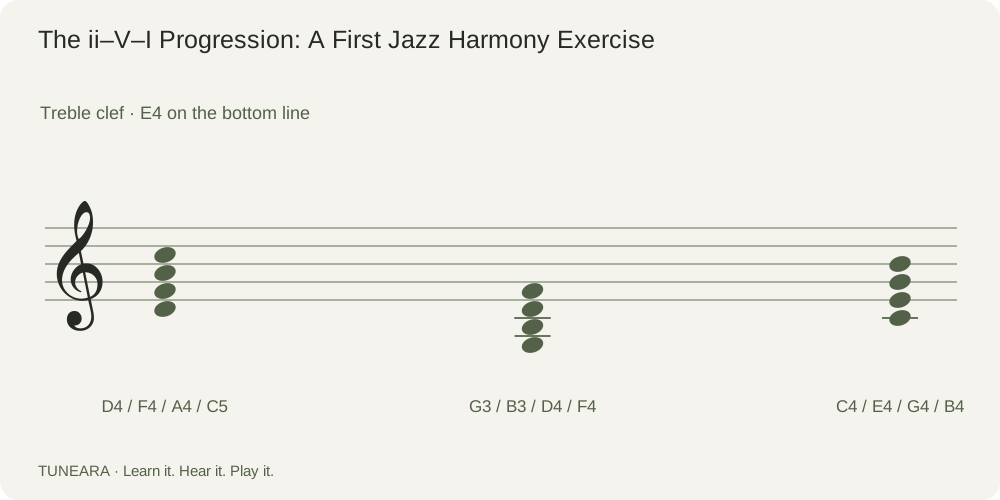
In a major key, ii–V–I commonly uses a minor seventh, dominant seventh, and major seventh chord. In C: Dm7–G7–Cmaj7.
How the ii–V–I progression connects chord roots
The roots move by descending fifths or ascending fourths. Thirds and sevenths often provide compact connections between chords. This progression is widely useful in jazz study, but its treatment varies by style. Start with clear chord spellings and an even pulse before adding extensions or substitutions.
Follow the chord tones in Dm7–G7–Cmaj7
Dm7 contains D–F–A–C, G7 contains G–B–D–F, and Cmaj7 contains C–E–G–B. Notice F can remain from Dm7 into G7, then fall to E. C can fall to B between Dm7 and G7. Those small movements help explain why voicing matters beyond the bass-root pattern.
Try it in practice
Play roots D–G–C first. Then play the thirds and sevenths F/C, B/F, and E/B in comfortable registers, followed by complete chords if your instrument allows them. Give Dm7 and G7 two beats each and Cmaj7 four. Keep that timing fixed while selecting easier voicings.
Avoid a common mistake
Do not apply the major-key formula unchanged to every minor ii–V–i. Minor progressions often use a half-diminished ii and an altered dominant context. Also avoid adding many upper notes before you can hear the root, third, and seventh relationships in a simple version.
Read the visual example
What to learn next
Connect this lesson to Major Triads: Build Root, Third, and Fifth, then try Minor Triads: Lower the Third, Keep the Fifth.
References and further learning

Get Tuneara
Your next practice
starts here.
A free tuner and metronome for iPhone and Android.