Violin Tuning: GDAE Targets and a Careful Routine
← Back to Instrument tuning guides
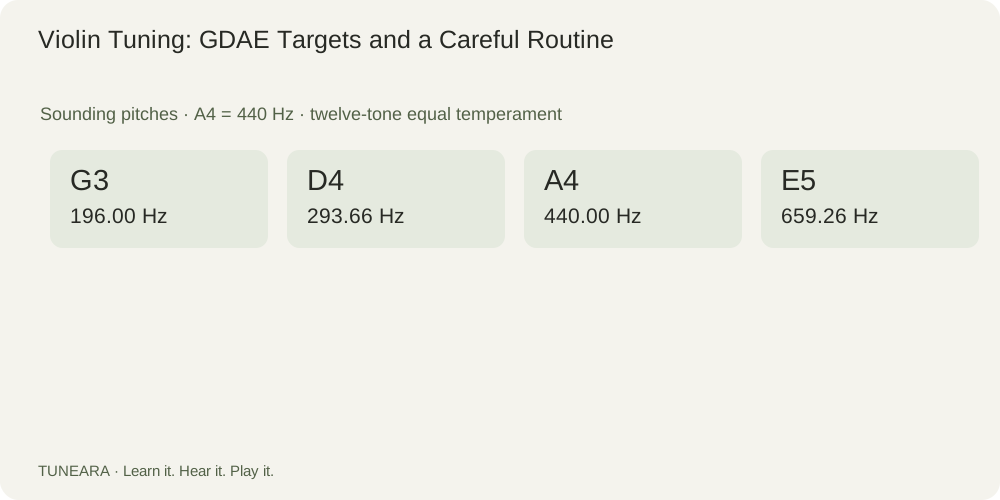
Standard violin tuning is G3–D4–A4–E5 from the lowest to highest string. Use small adjustments and get guidance if pegs are stiff, slipping, or unfamiliar.
How violin fifths, fine tuners, and pegs work
Each neighboring open string is a perfect fifth apart. Establish the ensemble’s reference pitch before tuning; A4 = 440 Hz is common but not universal. Fine tuners and friction pegs operate differently. Fine tuners are convenient for small changes, while larger corrections may require controlled peg movement.
Check G3, D4, A4, and E5 tuning frequencies
At A4 = 440 Hz, the equal-tempered targets are G3 about 196.00 Hz, D4 293.66 Hz, A4 440.00 Hz, and E5 659.26 Hz. Some players refine fifths by ear for the ensemble context, so distinguish a chosen musical adjustment from a mistaken note or octave.
Try it in practice
Begin with A and compare the other open strings individually using a reliable reference. Bow gently or pluck consistently, damping neighboring strings when the display is uncertain. Make one small correction, then listen again. Recheck the entire set after adjusting because the instrument can respond to the overall tension change.
Avoid a common mistake
Do not force a stuck peg or overtighten the high E to satisfy an unstable reading. A teacher or repairer can help with peg fit, bridge position, and safe handling. A violin’s setup and bridge require care beyond the generic guitar instruction to turn a tuning key.
Read the visual example
What to learn next
Connect this lesson to pitch, frequency, and cents, then try standard instrument targets.
References and further learning

Get Tuneara
Your next practice
starts here.
A free tuner and metronome for iPhone and Android.