Voice Leading: Connect Chords with Small, Clear Movements
Voice leading follows individual notes as chords change. Keep common tones where useful and move other voices deliberately instead of treating each chord as an isolated shape.
How individual notes move between chords
A voice is a musical line, not necessarily a singer. Keyboard hands, guitar strings, or ensemble instruments can carry separate lines. Nearby movements often make a progression easier to hear and play, but smoothness is a choice, not a universal rule. Leaps and changing textures can also be intentional.
Connect C–E–G to C–F–A with small movements
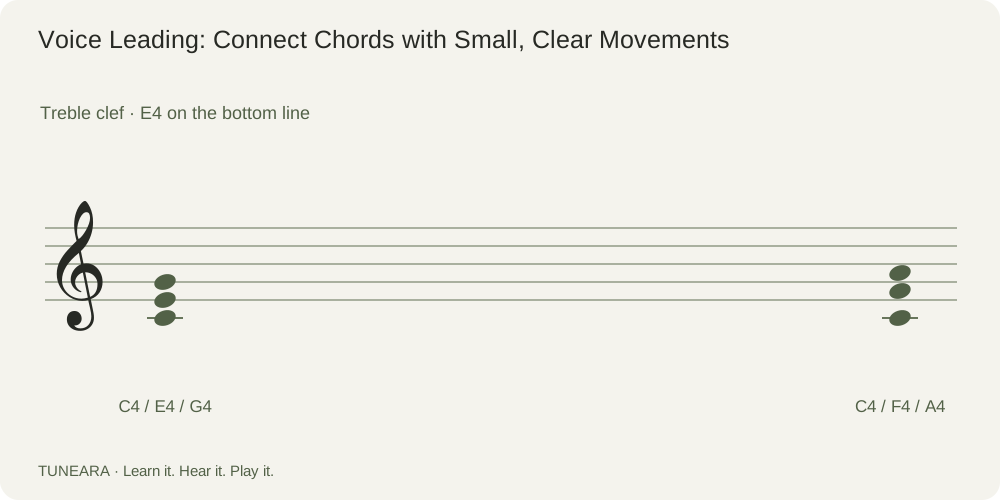
C major as C–E–G can move to F major as C–F–A. C remains, E rises to F, and G rises to A. The root of F major is F even though C is lowest in that voicing. This example connects the chords with small upper movements while choosing an inversion.
Try it in practice
Write the two three-note voicings in columns and draw a line between corresponding voices. Play each line by itself, then combine them. Try moving back to C with the same voice paths. Listen for a note that jumps unnecessarily and see whether a different inversion makes the transition clearer.
Avoid a common mistake
Do not judge every style using a single list of classical part-writing restrictions. Parallel intervals, doubling, and spacing can have different roles across idioms. Keep the goal explicit: this beginner exercise trains awareness of individual pitch motion, not compliance with every historical composition convention.
Read the visual example
What to learn next
Connect this lesson to Major Triads: Build Root, Third, and Fifth, then try Minor Triads: Lower the Third, Keep the Fifth.
References and further learning

Get Tuneara
Your next practice
starts here.
A free tuner and metronome for iPhone and Android.

