Compound Meter: Feel 6/8, 9/8, and 12/8
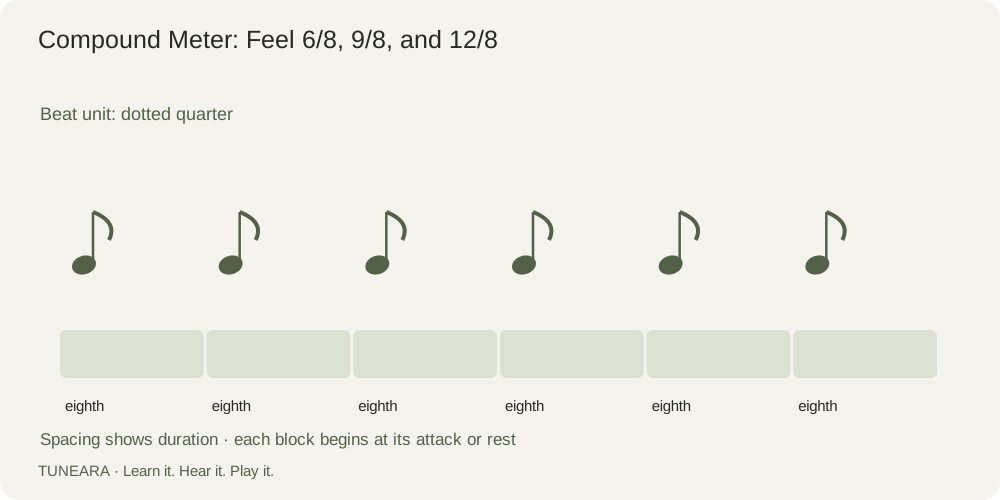
Compound meter divides each main beat into three parts. Common 6/8 has two dotted-quarter beats, 9/8 has three, and 12/8 has four.
How compound meter groups notes in threes
The top number describes written subdivision units per measure, not always the number of main beats. In a typical 6/8, six eighths group as three plus three. Each group equals a dotted quarter. At slow tempos, performers may count smaller units; the underlying grouping still helps explain the phrase.
Count the main beats in 6/8, 9/8, and 12/8
Count 6/8 as “1 la li 2 la li.” The numbers mark the two main beats. Contrast 3/4 at the same eighth-note spacing: “1 and 2 and 3 and” produces three groups of two. Both contain six eighth notes but organize emphasis differently.
Try it in practice
Clap six evenly spaced sounds. Accent sounds 1 and 4 for a 6/8 grouping, then sounds 1, 3, and 5 for a 3/4 grouping. Keep the small-note spacing unchanged. Next, play only the accented sounds so the two-beat versus three-beat structure becomes obvious.
Avoid a common mistake
Do not assume the eighth note equals one main metronome beat just because the denominator is 8. Check the tempo marking’s note value. If dotted quarter = 60, eighth subdivisions occur at 180 per minute. Some scores use unusual groupings; follow beams, accents, and musical context.
Read the visual example
What to learn next
Connect this lesson to BPM and beat length, then try time signatures and beat grouping.
References and further learning

Get Tuneara
Your next practice
starts here.
A free tuner and metronome for iPhone and Android.

