How to Count Sixteenth Notes: 1 E And A
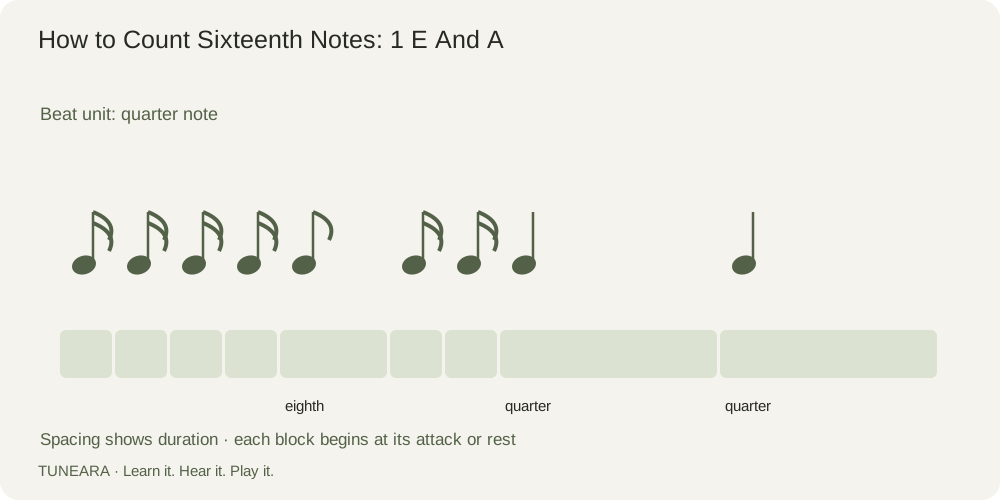
With quarter-note beats, count sixteenths as “1 e and a, 2 e and a.” Each beat divides into four equal parts in straight rhythm.
How four sixteenth notes fit into one beat
The number marks the beat, “e” the second quarter of the beat, “and” the halfway point, and “a” the final quarter. The syllables are a counting convention, not lyrics or required accents. Keep the spacing even and the voice relaxed before adding a fast instrumental passage.
Place “1 e and a” against a quarter-note pulse
In one beat, an eighth note followed by two sixteenths starts on “1,” “and,” and “a.” Two sixteenths followed by an eighth starts on “1,” “e,” and “and.” Both fill the same beat, but their attacks occur in different places. Beams often group the notes to show that shared beat.
Try it in practice
Tap quarter notes and speak four syllables per tap. Clap only “1” and “and,” then add “a,” then try the complete four-note group. Practice a single beat followed by a beat of rest so you can reset without losing the measure. Increase tempo only after the subdivision stays even.
Avoid a common mistake
Do not squeeze the last two sixteenths into the next beat. Repeatedly playing the whole pattern faster can hide that unevenness. Also avoid accenting every counting syllable equally on the instrument: the count locates positions, while the phrase determines the expressive accents.
Read the visual example
What to learn next
Connect this lesson to BPM and beat length, then try time signatures and beat grouping.
References and further learning

Get Tuneara
Your next practice
starts here.
A free tuner and metronome for iPhone and Android.